Repiping means replacing the pipes that carry drinking water around a building: the hot and cold supply lines from the main valve to every faucet, toilet, shower and appliance. In San Francisco it usually means taking out galvanized steel or aging copper and putting in PEX or new copper under a DBI plumbing permit, then testing the new system and having the city inspect it before the walls close. Hilltop Repipe San Francisco offers and manages whole-house and partial repipes across San Francisco, Daly City and South San Francisco, with the work carried out by licensed and insured contractors. This guide covers the whole process, from the first symptom to the last patch.
What the water supply system is
A building’s plumbing is two separate systems that meet at the fixtures. The supply system carries pressurized drinking water in: cold from the street, and hot from the water heater. The drain, waste and vent system carries used water out by gravity to the sewer. A repipe replaces the supply side only. The guide to whether repiping includes drain pipes covers the other half.
On the supply side, water arrives through the service line, the buried pipe from the meter box at the sidewalk to the building. San Francisco’s code requires a fullway valve where it enters, and from there a main line, the trunk, runs through the garage ceiling, basement or crawlspace. Risers climb to each floor and branches split off to each fixture group, each ending at a stop valve under a sink or behind a toilet. A second set of lines leaves the water heater and follows the same path. In a building with more than one unit, the system also branches by unit, and San Francisco requires that each unit can be shut off on its own.
What San Francisco buildings were piped with
The pipe in a building usually dates from when it was built or last remodeled, and San Francisco’s housing is old. The U.S. Census Bureau counts 45.2% of the city’s housing units as built in 1939 or earlier, another 16.1% from 1940 to 1959 and only 23.5% in 1980 or later. Half of all units are in buildings of five or more, and another fifth in buildings of two to four.
Galvanized steel was the common supply pipe in American houses of the early twentieth century: threaded steel pipe dipped in zinc. Copper tube took over in the following decades, joined with solder rather than threads. Plastics came later. Polybutylene was used in the 1980s and early 1990s and is rarely found in San Francisco, where none of 273 repipe permit descriptions from 2021 to 2025 mention it. PEX and CPVC are the plastics approved today.
Most older buildings hold more than one of these, because a leak was fixed in whatever was standard that year. A 1920s flat can have galvanized risers, a copper bathroom group from a remodel and a stretch of PEX where a plumber cut out a leak. Among the 273 permit descriptions that describe domestic water repiping in the city, 76 name galvanized pipe and 92 name copper.
Why those materials were used
Each material solved the problem of its day. Galvanized steel was strong, cheap and could be threaded on site with hand tools, and its zinc coating slowed rust for the first decades. Copper was lighter, did not rust, and its smooth bore carried more water for its size. It was joined with solder in minutes, which made it faster to install in tight walls.
PEX is crosslinked polyethylene tubing. It comes in long coils, bends around obstacles, and needs fittings only where it branches or ends, so it can be fished through a finished building with fewer openings. CPVC is a rigid plastic joined with solvent cement. All of them, along with copper, are listed for water distribution in Table 604.1 of the 2025 California Plumbing Code, which San Francisco adopts with local amendments. The guide to whether PEX is allowed in California covers the state rules in detail.
How to tell what you have
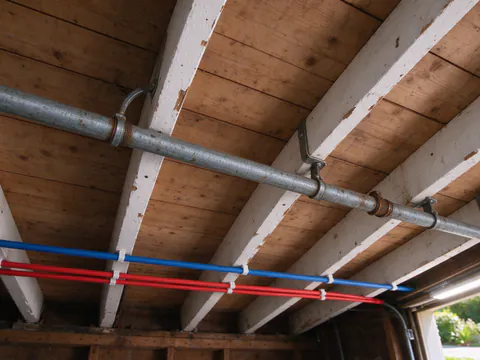
Start where the pipe is exposed: the garage ceiling, a basement, a crawlspace, the line at the water heater or behind an access panel. Galvanized steel is dull gray, has threaded joints with visible fittings, and a magnet sticks to it. Copper is reddish brown, or green where it has oxidized, with smooth soldered joints, and a magnet does not stick. PEX is flexible tubing, often red, blue or white, printed with its rating. Polybutylene is usually gray plastic, sometimes stamped with a PB code.
What shows in the garage is not proof of what is in the walls. Copper at the water heater and galvanized in the risers is a common combination. The guide to identifying pipe material has photos and a step-by-step check.
Why old supply pipe fails in San Francisco water
The mechanism depends on the pipe and on the water, and San Francisco’s water is unusual. SFPUC reports average hardness of 62 ppm, a pH of about 9.3, adjusted for corrosion control, and chloramine as the disinfectant. Up to 85% of the supply comes from Hetch Hetchy. The guide to San Francisco water and your pipes covers the chemistry.
Galvanized steel
The zinc wears through first, then the steel corrodes from the inside. Rust builds on the pipe wall, narrowing the bore until a 3/4-inch pipe carries the water of a much smaller one. In hard-water cities scale adds to that. In San Francisco’s soft water it mostly doesn’t, so a galvanized line that loses flow is usually clogged by its own corrosion. The corrosion is worst at threaded joints, where the wall is thinnest, which is where galvanized pipe tends to leak. The utility’s pH adjustment slows metal from leaching into the water but cannot undo decades of internal rust. The guide to whether galvanized pipes are safe covers what that means for drinking water.
Copper
Copper fails mostly at pinholes and joints, and there is no single cause. Water chemistry, flow velocity, sediment, workmanship at the joints and electrical conditions can each play a part. One pinhole does not prove the rest of the system is failing; several on the same run, or green crust at many joints, is a stronger signal. The copper pinhole leaks guide goes into the causes.
Where metals meet
When copper is joined directly to steel, the two metals form a galvanic couple and the steel corrodes faster at the joint. San Francisco’s code requires a dielectric or insulating fitting, or a brass nipple at least 6 inches long, at every copper-to-steel connection. Mixed systems without them tend to leak at those joints first.
Symptoms, and what they do and don’t prove
- Low pressure or flow at several fixtures. A common sign of clogged galvanized pipe, but a partly closed valve, a failing pressure regulator, the service line or clogged aerators look the same. The low water pressure guide sorts the causes.
- Rusty or brown water. Often galvanized pipe shedding rust, especially after a shutoff, but a water heater or utility work can do it too. The rusty water guide covers how to tell.
- Repeat leaks. Leaks at threaded joints suggest corroded galvanized; repeated pinholes in one run of copper suggest a problem with that run.
- Water stains on a ceiling. A leak somewhere above, which may be a supply line, a drain or a shower pan. It needs tracing before anyone prices a repipe.
- A leak alert from the utility. SFPUC flags continuous use from its hourly meter data. The SFPUC leak alert guide explains what it means.
Freeze damage is not on this list. NOAA’s normals for downtown San Francisco record no nights at or below freezing in an average year, so cold-climate freeze advice does not apply here.
Lead and San Francisco’s pipes
SFPUC removed all known lead service lines in the 1980s, about 7,000 of them, and its plumbers have never observed a lead service line on the owner’s side, estimating a 1% chance of lead in customer-owned lines. In SFPUC’s 2024 tap sampling at 50 homes, the 90th percentile lead level was 4.9 parts per billion, against an action level of 15. SFPUC lists the source as corrosion of household plumbing, meaning old solder, brass fixtures and galvanized pipe that once sat downstream of lead, not the city’s mains. A lead test costs $25 per tap through SFPUC. The lead pipes in San Francisco guide covers the utility’s program and the owner’s side.
How the scope is set
A good assessment turns symptoms into facts before anyone talks about scope. It starts at the meter box and the main valve and measures static pressure, because San Francisco is served through about 13 pressure zones fed from reservoirs and tanks at different elevations, and pressure at one address says little about the next. Then the pipe is traced: the material of the service line, the trunk, each riser and each branch; how many fixtures; which walls are plaster, drywall or tile; where the water heater sits; and which garage ceilings, basements, crawlspaces, closets or attics could carry new pipe without opening a finished room.
What that inspection finds sets the scope. If the pipe is galvanized throughout, the question is not whether to replace it but how much at once. If most of the system is sound copper with one bad run, a repair or a partial repipe may be enough. If pressure at the meter is low, new pipe will not fix it. The result should be a written scope that names the material, the layout, the boundary between new and old pipe, every planned opening, the permit and who patches what.
Scope options: repair, partial repipe or whole house
- Repair a section. Cut out the leak and replace a short length. It fits when the pipe around the leak is sound. In San Francisco, repairing a leak without cutting into or removing pipe is exempt from a permit; cutting out a section is not.
- Partial repipe. Replace one floor, one riser, one bathroom group or one unit, and record the old pipe that stays. The boundary matters because old steel upstream can keep shedding rust into new pipe, and every copper-to-steel joint needs a dielectric fitting. The partial repiping page covers it.
- Whole-house repipe. Replace every supply line from the main valve to each fixture. It fits when galvanized runs through the house or leaks keep coming. The whole-house repiping page covers it.
- Epoxy lining. Coat the inside of the existing pipe instead of replacing it. The pipe lining vs repiping guide compares the two.
The repipe vs repair guide walks through the decision, and the repiping assessment gives a planning answer from a few questions.
Choosing the material and layout
PEX and copper are both code-approved, and neither is right for every building. PEX bends through joists and up walls with few fittings, which usually means fewer openings and a lower price. Copper is a rigid metal system with more joints. Copper tube must be at least Type L, with Type M allowed above ground in or on a building. The PEX vs copper guide sets out the tradeoffs, and the PEX-A vs PEX-B guide covers the two common PEX types.
California adds rules worth knowing. PEX installed in the state must have at least 30-day UV protection, and PEX-AL-PEX is not adopted for drinking water in housing. The two-flush, one-week tagging procedure applies to PEX only as the first piping in new construction, not when it replaces an existing system, so a PEX repipe does not add that week. CPVC inside a home carries certifications, a two-flush procedure and ventilation rules at permit time, which helps explain why most repipes in California use PEX or copper.
Layout is the other choice. Trunk-and-branch copies the old system: a main line with tees to each fixture group. A home-run manifold runs one line from a central valve board to each fixture. The manifold vs trunk-and-branch guide compares them.
Permits, licensing and San Francisco’s code
DBI states that a permit is needed “before cutting into or replacing pipes, particularly pipes that will be covered by a wall or buried in the ground.” Since September 14, 2026, new plumbing permits without plans are filed and inspections scheduled only on PermitSF. The permit is filed by a contractor holding a qualifying California license, C-36 plumbing or C-4 among them, or by the owner of a stand-alone single-family house who lives there. A house permit is $549, or $809 with underground work, and DBI requires a separate permit for each condo and apartment unit. The San Francisco repiping permit guide covers the steps, and gas piping has its own permit, covered in the gas line permit guide.
The 2025 San Francisco Plumbing Code, in force since January 1, 2026, is the state code with local amendments that shape a repipe:
- A fullway valve where the supply enters the building, a separate valve for each building on a lot and a valve on each water heater’s cold supply.
- Shutoffs in each dwelling unit, so its hot and cold can be turned off without interrupting the others, with any remodeled unit brought up to that rule.
- A control valve ahead of each fixture’s hot and cold supply.
- Dielectric or insulating fittings, or 6-inch brass nipples, where copper meets steel.
- Air chambers at quick-closing valves such as single-handle faucets, shower valves and flushometers.
- A backflow assembly near the meter for buildings four or more stories tall, or where the supply rises more than 40 feet above the meter.
State code adds a pressure regulator with a strainer and an expansion tank where static pressure exceeds 80 psi, and water heater straps in the upper and lower thirds of the tank. Daly City and South San Francisco issue their own plumbing permits through their building divisions, and San Francisco’s local amendments do not apply there.
Buildings with more than one household
Flats and apartment buildings change the job more than any material choice. Each unit needs its own shutoffs, so one unit can be worked on while the others keep water. DBI issues a permit per unit, and its fees climb with the unit count, from $1,045 for 7 to 12 units to $8,679 for more than 36. Risers often serve a stack of units, so replacing one unit’s lines can mean opening walls in the unit above or below.
Paint in buildings built before 1979 is presumed to contain lead. Section 327 of the San Francisco Existing Building Code requires containment with plastic sheeting, signs at access points, notice to residents at least three business days ahead and HEPA cleanup for work that disturbs it in rentals and shared buildings. An owner-occupied unit is exempt from the interior rules but must still keep dust out of shared areas. Opening textured or skim-coated walls in a building of one to four units can also require asbestos sampling first.
In an occupied rental, the schedule decides the legal path. If the work can be staged so units stay habitable, with water back on each day, the temporary-eviction process does not come into play. If a unit would be hazardous or uninhabitable during the work, the Rent Ordinance’s temporary-eviction provision for capital improvements applies: permits must be issued before notice is served, the stay away is limited to three months unless the Rent Board extends it, and relocation payments are owed. Owners should confirm the details with the Rent Board or counsel. After the work, the Rent Board may certify new piping as a capital improvement, amortized over 20 years in buildings of one to five units and 10 years at half the cost in buildings of six or more. The capital improvement guide explains those rules, and the apartment building repiping page covers the work.
Insurance and programs
Homeowners insurance generally pays for sudden water damage under the policy’s terms, not for planned replacement of old pipe, and coverage varies by policy. The homeowners insurance guide explains the difference. No grant or rebate pays for an interior repipe in San Francisco, and repiping does not qualify for a federal tax credit. SFPUC replaces its own galvanized service lines at no direct charge and offers free lead tests and inspections to owners it has notified about a galvanized line on their side. For a water heater replaced at the same time, CleanPowerSF offers bill credits for heat pump models, and WestLight Energy offers rebates in Daly City and South San Francisco; the heat pump vs tankless guide and the guide to the Bay Area gas water heater rule cover that decision.
Not sure what your symptoms mean?
A walk-through traces the pipe from the meter and measures pressure before anyone talks about scope.
How the work happens
The order below is typical of a whole-house repipe. A partial repipe or a single unit follows the same steps on a smaller scale.
Shutting the water off and staging
The work is staged around the main valve and, in multi-unit buildings, the unit shutoffs. Where the main valve is missing, seized or inside the wrong wall, replacing it comes first, because everything after depends on isolating the water reliably. Work areas are protected, and in pre-1979 buildings openings are set up for lead-safe work. Water is shut off for each stage, not for the whole job.
Running the new lines
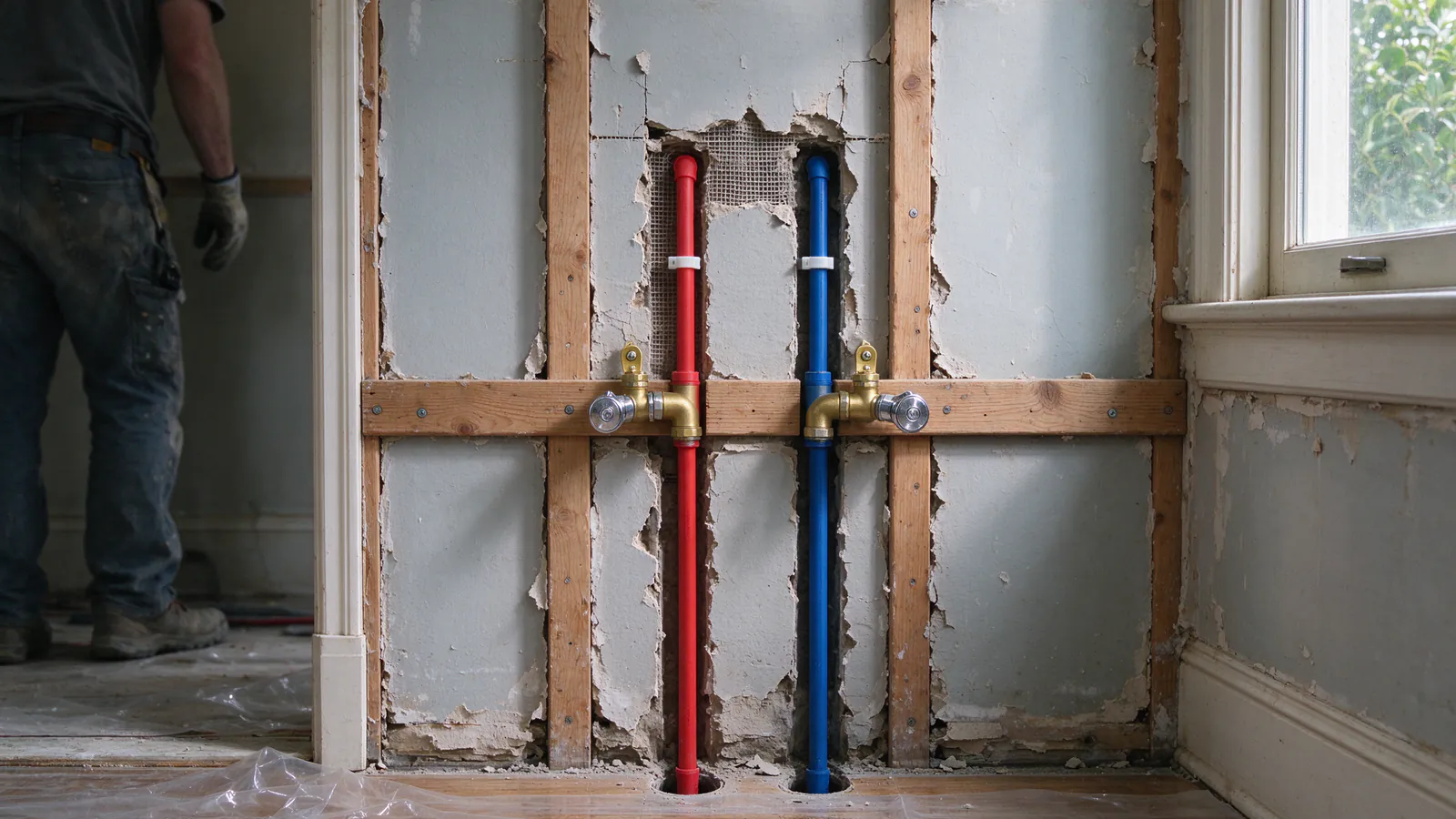
New lines are usually run while the old ones still serve, so the building keeps water during most of the work. The trunk goes in first, along the garage ceiling, basement or crawlspace where possible, then risers and branches are pulled up to each fixture through the planned openings. PEX is supported at its maker’s spacing, kept away from daylight and heat, and protected with steel plates where it passes close to a wall face. Copper is cut, joined and supported, with dielectric fittings wherever it meets steel that stays.
Cutting over and reconnecting
Each fixture group is switched to the new lines, with a new stop valve at every fixture and air chambers where the city requires them. The water heater is reconnected with a valve on its cold supply and compliant straps. If the meter-side pressure is above 80 psi, a regulator and expansion tank go in. Old pipe that is exposed is removed; pipe sealed in finished walls is drained, disconnected and left in place.
Pressure test, flush and inspection
Before any wall closes, the new system is tested with water at working pressure or with air at 50 psi or more, held for at least 15 minutes without leakage. Plastic pipe is air tested only where its maker allows it. The lines are flushed with aerators off, because rust loosened from old pipe can lodge in valve cartridges. The city inspector then sees the work under test. A failed inspection costs $259 per half hour to re-inspect in San Francisco, which is one reason to test thoroughly first.
Where metal water pipe has been replaced with plastic, the electrical bonding that once ran through it has to be checked, because the plumbing code requires like material where metal supply pipe is the grounding electrode and the electrical code requires remaining metal water pipe to be bonded. A licensed electrician confirms it.
Patching
Openings are closed after inspection. Drywall is patched and taped; original plaster and lath takes more work to match. Who patches, how far and whether painting is included should be settled in the scope, not at the end.
Living through a repipe
Most people stay home during a house repipe. The water is off in stages rather than for the whole job, because new lines are run before the old ones are cut over. Expect noise, dust kept inside containment, and openings in the rooms where fixtures are. Kitchens and bathrooms are the hardest rooms to work around. The how invasive is repiping guide shows where openings tend to land, and the how long does repiping take guide covers the schedule. In flats, neighbors keep water because their units have their own shutoffs.
What it costs
A typical San Francisco-area range for a whole-house PEX repipe is $8,500 to $16,000 for one bath, $12,000 to $22,000 for two and $14,500 to $28,000 for three; multi-story or hard-access homes can run higher, and copper usually costs more, by a margin sources put anywhere from about 10% to 60%. The price moves with fixture count, stories, access, wall finishes, material and layout, the city’s required valves, lead-safe setup, the service line and how much restoration is included. Plumbers in the San Francisco-Oakland-Fremont metro earn a mean $44.41 an hour against $34.70 nationally, according to the Bureau of Labor Statistics, which explains part of the local premium. The repipe cost guide breaks it down, and the cost estimator gives a range without a phone call.
What old pipe costs while it stays
Leaving old pipe in place has a running cost. A leak at SFPUC’s alert threshold of 7.5 gallons an hour, left running for a 30-day month, wastes 5,400 gallons. At SFPUC’s published single-family water and sewer rates, which change each fiscal year, that adds roughly $233 to a month’s bill. SFPUC’s leak allowance can credit part of it, half for a visible leak and all of it for a concealed one, for up to two billing periods, if the owner applies within 15 days and proves the repair. The bigger cost is a sudden failure. The burst pipe guide covers what to do in the first minutes, and emergency pipe repair is available 24/7 in an emergency.
Living with a new system
A new system needs little, but a few habits help. Know where the main valve is and keep it reachable. Shutoffs labeled by fixture or unit save time later. If a pressure regulator was installed, its setting is worth checking every few years, and an expansion tank can lose its air charge. The water heater keeps its own maintenance schedule, and its straps stay a legal requirement for as long as it stands. No honest source can promise a set number of years for new pipe in a particular building: product, water chemistry, workmanship and support all affect how it ages.
Buying or selling with old pipe
Inspection reports in San Francisco often name galvanized pipe. A buyer may price that risk higher than the repipe costs, and a written scope and price lets both sides negotiate with numbers. California also requires a seller to certify in writing that the water heater is braced, anchored or strapped. The guide to buying a house with galvanized pipes covers the negotiation.
Questions to ask before agreeing to a repipe
- Was static pressure measured at the meter, and what was it?
- Which pipe is being replaced, and which old pipe stays?
- PEX or copper, which fitting system, and trunk-and-branch or manifold?
- Are the valves, unit shutoffs and air chambers San Francisco requires all in the scope?
- Is the service line from the meter box included, and if not, what is it made of?
- How are the water heater connections, straps and any regulator or expansion tank handled?
- Which permit category, and who files it and meets the inspector?
- How many openings, where, and who patches and paints each one?
- In a pre-1979 building, how is lead-safe work handled?
- In an occupied rental, how is the schedule kept inside the Rent Board’s rules?
The quote comparison checklist puts these on one page. For a walk-through of your building, call or send the form; the assessment starts at the meter.