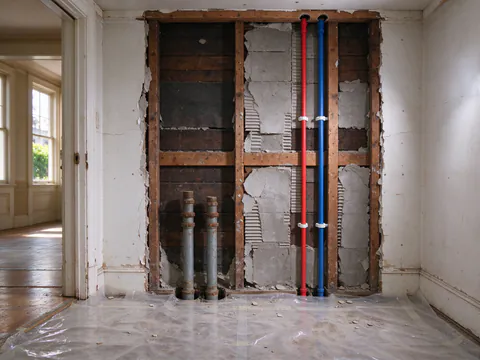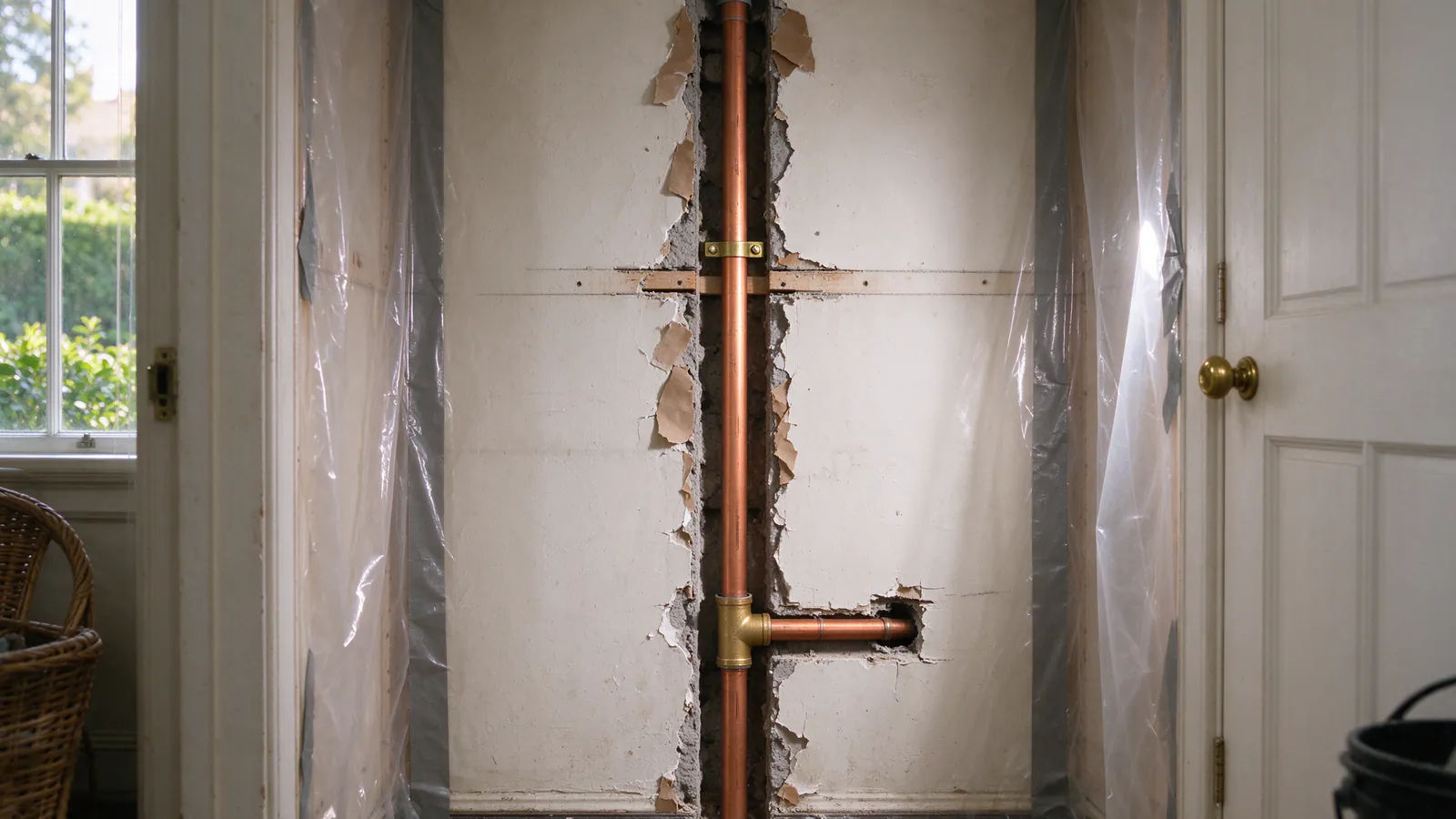
Often, yes. The San Francisco Rent Board’s amortization schedules list “new plumbing (new fixtures or piping)” as a capital improvement, so new supply piping can be certified after the work and part or all of its cost passed through to rented units over 10 or 20 years, depending on building size. Clearing a clogged pipe or patching a leak is repair and maintenance, and is not. Hilltop Repipe San Francisco offers and manages apartment building repiping across San Francisco, with the work carried out by licensed and insured contractors.
This is a plain-language summary of public Rent Board rules, not legal advice. Certification is the Rent Board’s decision, and owners should confirm their own situation with the Board or with counsel before serving any notice or filing a petition.
What counts as a capital improvement
The Rent Board defines a capital improvement as work that materially adds to the value of the property, appreciably prolongs its useful life or adapts it to new uses. Repair and maintenance do not qualify; the Board’s own example is clearing a clogged pipe. A repipe that replaces a building’s galvanized or failing copper supply system with new pipe fits the first two tests, and the amortization schedules in Section 37.7 of the Rent Ordinance and Rule 7.12 of the Board’s Rules and Regulations list new piping by name.
Two qualifications matter. First, work done to correct a code violation that was left unabated for 90 days or more after a notice of violation is generally not certified, unless the owner made timely, good-faith efforts to fix it. Second, keeping records of when problems appeared, when notices arrived and when work was ordered helps show the timeline if it is questioned.
How long the cost is spread
The amortization period depends on the number of residential units in the building and the type of improvement. For new plumbing:
| Building | Amortization | Share that can pass through | Cap per 12 months |
|---|---|---|---|
| 1 to 5 residential units | 20 years (Schedule III, which lists new piping) | 100% of certified cost | Greater of $30 or 5% of base rent |
| 6 or more residential units | 10 years (Schedule II, which lists new piping) | Generally 50% of certified cost | Greater of $30 or 10% of base rent |
| 6 or more, if the resident elects | 10 years | 100% of certified cost | 5% of base rent per 12 months and 15% in total |
| Work required by a law enacted after November 14, 2002, or seismic work required by law | 20 years | 100% | Greater of $30 or 10% of base rent |
Water heaters are treated as fixtures on a shorter schedule: 10 years in buildings of one to five units and 7 years in buildings of six or more. A repipe that also includes water heater replacement may therefore have two lines in the petition with different periods. The Rent Board adds imputed interest at a rate it sets for each 12-month period beginning March 1, and that rate varies with the amortization period.
As an illustration only, in a building of one to five units, a unit with a base rent of $2,000 a month could see capital improvement passthroughs raise its rent by no more than $100 a month in any 12-month period, because 5% of $2,000 is greater than $30.
Filing the petition
The petition is filed after the work is complete, within five years. In a building of six or more units, if the cost is expected to exceed $25,000 times the number of units, the owner must inform each resident and the Rent Board in writing within 30 days. An estimator fee may apply where costs exceed $25,000 without competitive bids or time-and-materials billing. Residents may file a financial hardship application in response to a passthrough.
For the petition, the useful records are the ones a repipe produces anyway: the written scope and price, the DBI permits (one for each apartment unit, as DBI requires), inspection results and final invoices. A scope that separates new piping from wall restoration and from any water heater work makes it easier to show what each part cost. The San Francisco repiping permit guide covers the permits, and the repipe cost guide explains what a full scope lists.
Planning a repipe in an occupied building?
A walk-through maps risers, unit shutoffs and access, and the written scope is staged around residents and the Rent Board's rules.
Keeping residents in place
The other Rent Board question is whether residents can stay during the work. Where the job can be staged around them they can, and that is worth planning for. San Francisco’s plumbing code requires each dwelling unit to have shutoffs so its hot and cold water can be turned off without interrupting others, and new lines are usually run while the old ones still serve, so water goes off in stages rather than for days. If the schedule keeps every unit habitable, with water restored each day and openings protected, the temporary-eviction process does not come into play.
Staging decisions that help: working one riser or one stack at a time, closing openings in occupied rooms the same day where possible, planning kitchen and bathroom work around residents’ schedules, and giving written notice of each shutoff. The how invasive is repiping guide shows where openings tend to land, and the how long does repiping take guide covers scheduling.
When a unit must be vacated
If a unit would be hazardous, unhealthy or uninhabitable while work is in progress, Rent Ordinance Section 37.9(a)(11) allows a temporary eviction to carry out capital improvements, in good faith and for the minimum time required. Its conditions are specific:
- Permits first. All necessary permits must be obtained on or before the date the notice to vacate is given.
- Notice contents. The notice includes copies of the permits, a description of the work, an approximate reoccupancy date (month and year), the current lawful rent, relocation rights with Section 37.9C attached, and the Board’s forms, and it is filed with the Rent Board within ten days of service.
- Three months. A tenant cannot be required to vacate for more than three months unless the Board extends the period on the landlord’s application.
- Relocation payments. For displacement of 20 days or more, Section 37.9C payments apply, half at notice and half on vacating. The amounts are adjusted each March 1; the current published figures are $8,245 per tenant, up to $24,733 per unit, plus $5,497 for each elderly or disabled tenant or household with minor children. For displacement under 20 days, California Civil Code 1947.9 governs, currently at $446 per day.
- Longer stays for lower-income households. The section also provides that a lower-income household required to vacate for more than three months may receive monthly assistance toward the difference between their rent and the Housing Authority payment standard, for up to 39 months.
- Return. When the work is done, the owner offers reoccupancy in writing at the prior rent as adjusted; the household has 30 days to accept and 45 days to move back, and the offer is filed with the Board within 15 days.
These figures change on a set schedule, so check the Rent Board’s current amounts before relying on them.
Other rules that apply to rented buildings
Paint in a building built before 1979 is presumed to contain lead, and in rented and shared buildings Section 327 of the San Francisco Existing Building Code requires containment, posted signs at access points, written notice to residents at least three business days before work and HEPA cleanup. Penalties run up to $500 per violation per day. California also requires every residential water heater to be strapped against earthquakes, and a landlord may not evict on the ground that eviction is needed to comply with that requirement.
Putting the numbers together
The cost of the repipe itself depends on the building: unit count, risers, access through shared walls, wall finishes and how much restoration is in scope. Flats and apartment buildings hold most of the housing in districts such as Mission and Noe Valley and Pacific Heights and the Marina, and those pages describe the buildings there. For a single unit in a condominium building, condo and HOA repiping covers the association’s role. DBI requires a permit for each existing apartment unit, and its fees climb with unit count, from $1,045 for a building of 7 to 12 units to $8,679 for more than 36. The apartment building repiping page covers how those buildings are scoped, and the homeowners insurance guide explains why insurance generally won’t fund planned replacement.
For a written scope that is staged to keep units occupied and itemized for a petition, call or send the form with the number of units and floors.