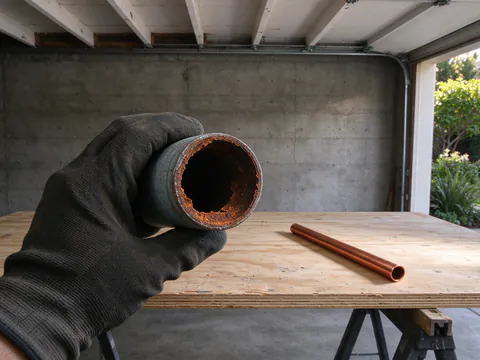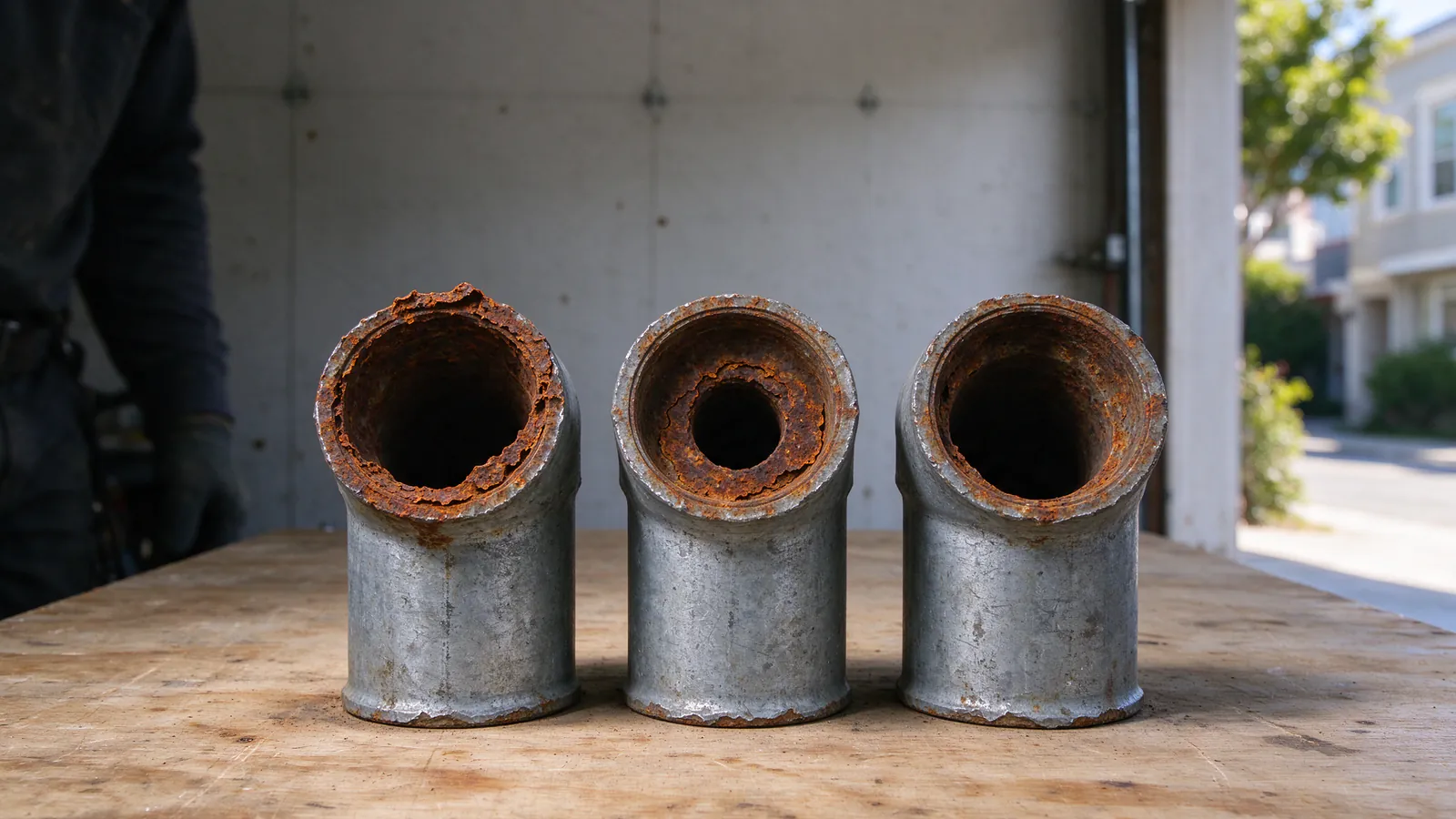
Galvanized pipe is usually not a direct health hazard in San Francisco: it is steel, not lead, and SFPUC’s tap testing finds lead well below the action level. The concerns are that galvanized pipe once connected to lead can release lead from its rust, that old galvanized sheds rust and metal into the water, and that it eventually clogs and leaks. A $25 SFPUC lead test is the factual starting point.
Hilltop Repipe San Francisco manages galvanized pipe replacement and whole-house repiping across San Francisco, Daly City and South San Francisco, with the work carried out by licensed and insured contractors. This guide covers what galvanized pipe does to water, what local testing shows and how to decide what to do.
What galvanized pipe is
Galvanized pipe is threaded steel pipe dipped in zinc. It was the standard water pipe in American houses through the first half of the twentieth century, and San Francisco has a great deal of housing from that era: the U.S. Census Bureau counts 45.2% of the city’s housing units as built in 1939 or earlier. The zinc protects the steel for its first decades. Once it wears through, the steel rusts from the inside, the rust narrows the bore, and the wall thins most at the threaded joints, where it was cut thinnest to begin with.
Galvanized steel is still listed as an approved material in Table 604.1 of the 2025 California Plumbing Code, so a house with galvanized pipe is not out of code for having it. The question is condition, not legality. The guide to identifying pipe material shows how to tell what you have.
The lead question
Galvanized steel is not a lead pipe, but it can carry lead in two ways.
The first is history. Older water services were sometimes joined to the main with a short lead connector, about 3 feet or less, called a gooseneck or pigtail. Galvanized pipe downstream of a lead connector can collect lead particles in its rust and release them later, long after the lead itself is gone. SFPUC removed all known lead service lines, about 7,000 of them, in the 1980s, and it has been replacing the utility’s galvanized service lines with copper because they may have had lead connectors. Of the galvanized utility lines it removed, lead connectors were found on 19%. SFPUC has also identified 699 customer-owned galvanized lines it recommends replacing because they may have been connected to old lead pipes.
The second is fittings and solder inside the building. Old solder and brass were made long before today’s limits; the current California code allows a weighted average of no more than 0.25% lead on wetted surfaces. SFPUC lists “internal corrosion of household water plumbing systems” as the typical source of lead and copper in tap samples.
What SFPUC has not found is lead pipe on the owner’s side. From more than 9,000 site inspections plus modeling, it estimates a 1% chance of lead in customer-owned service lines, and its plumbers have never observed one. The lead pipes in San Francisco guide covers the utility’s program.
What San Francisco’s tap testing shows
In SFPUC’s 2024 tap sampling at 50 homes, the 90th-percentile lead level was 4.9 parts per billion, with a range from under 1 to 8.8, against an action level of 15. The 90th-percentile copper level was 72 parts per billion against an action level of 1,300. Those results describe the system as a whole, not any particular house.
The water helps. SFPUC adjusts the pH of its supply, which averages about 9.3, for corrosion control, which reduces how much metal old pipe gives up. It does not stop galvanized pipe from rusting internally over decades.
Daly City’s 2025 monitoring at 50 homes found the 90th-percentile lead level below 5 parts per billion, and the city reports no known lead service lines in its system. Cal Water, which serves South San Francisco, reports none in its systems either.
What rust in the water means
Galvanized pipe that is rusting sheds iron. Water that runs brown or orange after it has sat, after the water was shut off or when a tap is first opened in the morning is the usual sign. Day to day that shows up as stained fixtures, odd taste and clogged aerators, and it shows the pipe is corroding from the inside, and loose rust can lodge in valve cartridges and the water heater. The rusty water guide covers how to tell whether rust is coming from the pipe, the water heater or the street.
When galvanized pipe becomes a problem
For most owners the deciding factors are practical rather than toxic:
- Flow. Rust narrows the bore until a 3/4-inch pipe delivers the water of a much smaller one. Pressure at the meter is normal, but showers weaken when a second tap opens. The low water pressure guide separates pipe restriction from other causes.
- Leaks at threads. The threaded joints are where galvanized wall is thinnest and where it usually fails first. A leak at one joint often means the others are close behind.
- Mixed systems. Where copper was spliced into galvanized without a dielectric fitting, the steel corrodes faster at the joint. San Francisco’s code now requires a dielectric fitting or a brass nipple at least 6 inches long at every copper-to-steel connection.
- A notice from SFPUC. An owner who received a letter about a galvanized customer-side service line has a utility-documented reason to replace that line.
What to do about it
Start with a test. SFPUC tests tap water for lead at $25 per tap, and the test is free for owners who received a galvanized-line letter, who can also ask SFPUC to inspect the line at no charge. A result gives a fact to work from rather than a worry.
Then look at the pipe itself. A walk-through traces the material from the meter box to each fixture and measures static pressure, because galvanized often survives in pieces next to copper from later repairs. If the galvanized runs through the house, the galvanized pipe replacement page covers replacing it, usually as a whole-house repipe. If only the service line from the meter box is galvanized, water service line replacement covers that job, which the owner, not SFPUC, is responsible for. A typical San Francisco-area range for a whole-house PEX repipe is $8,500 to $16,000 for one bath, $12,000 to $22,000 for two and $14,500 to $28,000 for three, and the customer-side service line runs $2,000 to $6,000 as a national budgeting range.
Galvanized pipe in your building?
A walk-through maps where the galvanized is, measures pressure and puts the replacement in a written scope.
For flats and rented units
In a building with tenants, SFPUC tells occupants who receive a galvanized-line letter to pass it to the owner, since the customer-side line is the owner’s responsibility. Replacing galvanized in an occupied building means per-unit shutoffs, a DBI permit for each unit and, if a unit would be uninhabitable during the work, the Rent Board’s temporary-relocation rules. The apartment building repiping page covers those jobs.
Buying a house with galvanized pipe
Inspection reports in San Francisco often name galvanized pipe. It is not a reason by itself to walk away, but it is a cost to price. The guide to buying a house with galvanized pipes covers the negotiation. For a walk-through and a written scope for galvanized pipe in your building, call or send the form.