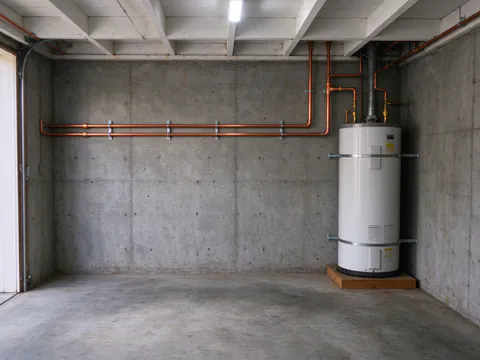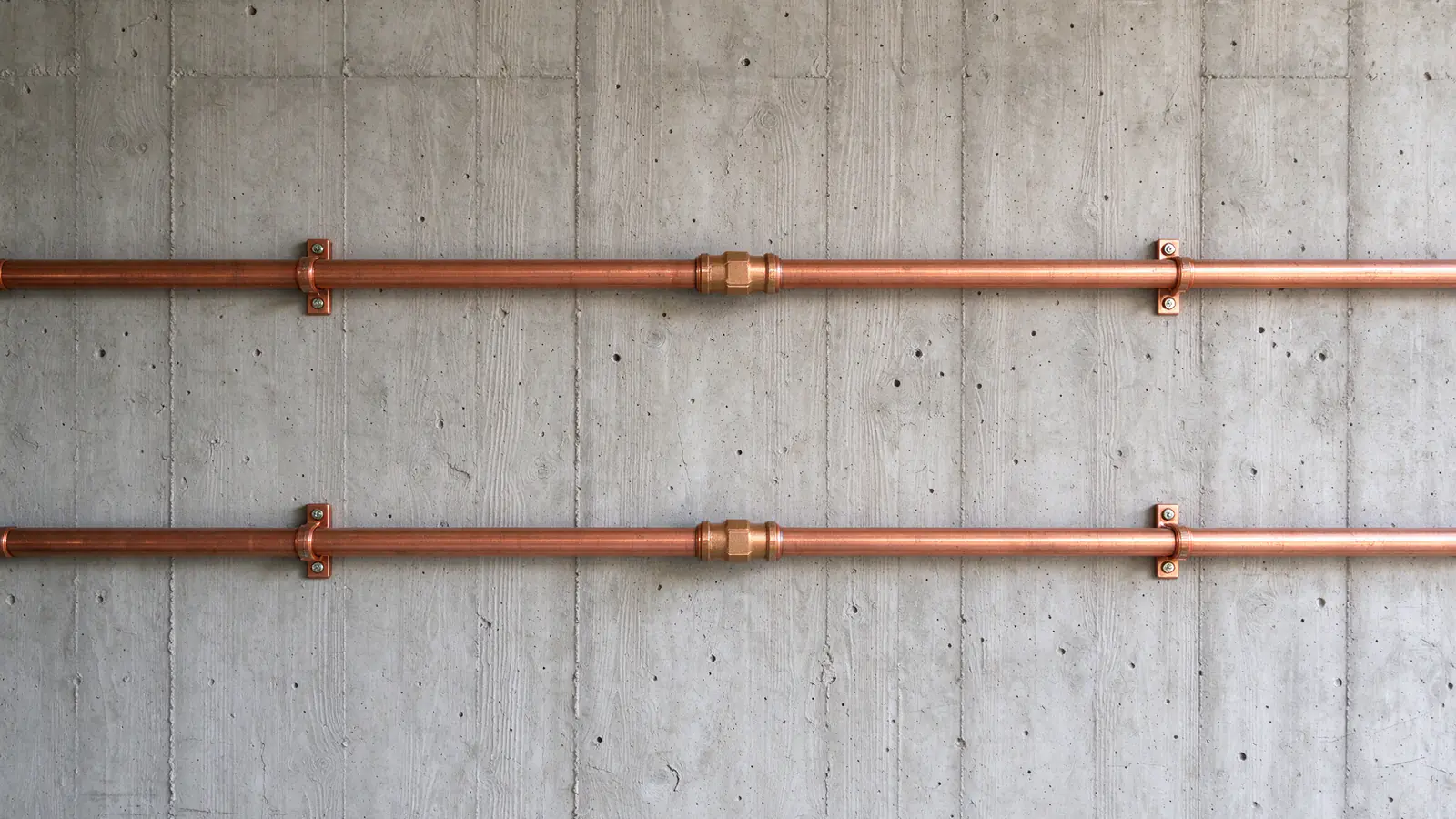
Copper pinhole leaks have no single cause. They form where the inside of the wall corrodes in one small spot until it breaks through, and that pitting can be driven by water chemistry, high flow speed, sediment, workmanship at the joints, stray electrical current or thin-walled tube. One pinhole doesn’t prove a system is failing; several on the same run usually point to a cause that will keep working.
Hilltop Repipe San Francisco handles leak repairs, copper repiping and repiping in other materials across San Francisco, Daly City and South San Francisco, with the work carried out by licensed and insured contractors. This guide explains how a pinhole forms, how to read the pattern and how to choose between a repair and a repipe.
How a pinhole forms
Copper protects itself with a thin oxide film on its inside surface. Most of the time that film keeps corrosion slow and even across the whole pipe, and the wall loses metal so gradually it outlasts the building. A pinhole happens when corrosion concentrates in one spot instead. Something breaks the film locally, a pit starts, and the chemistry inside the pit keeps it growing deeper rather than wider. The wall thins at that point until water pushes through a hole a fraction of a millimeter across.
Because the damage is inside, copper can look sound from the outside right up to the first drip. A small green or blue-green spot on the outside of a run, away from any joint, is often the first sign of a pit that has reached the surface. A pinhole leak usually starts as a fine spray or a slow drip that wets insulation, drywall or the floor below before anyone sees it.
What can drive the pitting
Several mechanisms are recognized in the trade, and more than one can act on the same pipe.
- Water chemistry. The balance of pH, alkalinity, dissolved minerals and disinfectant affects how stable the protective film stays. Very soft or aggressive water, and changes in treatment, can all play a part in some systems.
- Flow velocity. Water moving too fast for the pipe size wears away the film, especially at elbows, tees and just past fittings, where flow turns and churns. Hot water lines and recirculating loops run hotter and move water more often, which is why pinholes in some houses cluster on the hot side. This is often called erosion corrosion.
- Sediment and particles. Sand, scale or rust loosened from old galvanized pipe upstream can settle in copper and start pits beneath them.
- Workmanship. Excess flux left inside after soldering, burrs from cutting that were never reamed out, and joints overheated or underfilled can each start corrosion at the joint.
- Electrical conditions. Where metal water pipe is part of the electrical grounding path, stray current can flow through it. Faulty grounding or bonding is a possible contributor that an electrician checks.
- Thin-walled tube. Type M copper has a thinner wall than Type L, so a pit of the same depth reaches through sooner. California’s code requires Type L for water distribution, with Type M allowed above ground in or on a building.
Homeowners report pinholes in brand-new copper as well as in old systems, which is a reminder that age alone doesn’t explain them.
What the pattern of leaks tells you
The location of leaks is the most useful evidence a homeowner has. A log of where and when each leak occurred, with photos, helps whoever assesses the system.
- Hot side only, or mostly. Points toward temperature and velocity, including a recirculation pump that runs fast or constantly.
- Near elbows, tees and fittings. Points toward turbulence and erosion, or toward joint workmanship.
- Scattered along straight horizontal runs. Points toward water chemistry or particles settling on the bottom of the pipe.
- Concentrated where copper meets galvanized. Points toward galvanic corrosion at a mixed-metal joint; San Francisco now requires a dielectric fitting or a brass nipple at least 6 inches long there.
- One run, repeatedly. Points toward a cause specific to that run: its size, flow or how it was installed.
None of these proves a cause on its own. They decide what gets checked next.
What San Francisco’s water does and doesn’t explain
SFPUC’s water is soft, with average hardness of 62 ppm, a pH of about 9.3 adjusted for corrosion control, and chloramine as the disinfectant. In SFPUC’s 2024 tap sampling at 50 homes, the 90th-percentile copper level was 72 parts per billion against an action level of 1,300, which shows little copper being released at the tap across the system. No SFPUC source ties pinholes to the city’s water. Chloramine is a reasonable question for rubber seals and some fittings, which makers rate for it, but it is not an established cause of copper pinholes here.
South San Francisco is a different case. Cal Water blends local groundwater, with average hardness of 384 ppm, into its supply there, so scale and sediment inside pipes are a more real factor than in San Francisco. The guide to San Francisco water and your pipes covers the chemistry in more depth.
What to do when a pinhole leaks
Close the nearest stop valve, or the main valve if the leak is in a wall or ceiling. In San Francisco, SFPUC says most main shutoffs are outside the house or just inside, in line with the meter at the sidewalk; owners should not open the meter box. A leak that sprays into a wall or ceiling is an emergency, and emergency pipe repair is available 24/7 for burst and leaking pipe.
For houses and small buildings, SFPUC’s leak alert flags 48 hours of continuous use of at least 7.5 gallons an hour, and a concealed leak, one behind a wall or underground, qualifies for a credit of all of the excess use, against half for a visible leak, for up to two billing periods, if the owner applies within 15 days and proves the repair. A plumber’s invoice that describes a concealed leak matters for that claim. The SFPUC leak alert guide and the water leak detection page cover finding a leak you can hear but not see.
A second pinhole in the same pipe?
A walk-through looks at where each leak happened, what the copper is and what feeds it, then sets out repair or replacement in writing.
Repair, partial replacement or repipe
A single pinhole on otherwise sound copper is a repair. A listed repair clamp can stop it, and in San Francisco a repair that does not cut into or remove pipe is exempt from a permit. Cutting out the damaged length and joining in new tube is the more lasting fix and needs a permit, with the work inspected before the wall closes. The pipe repair page covers those jobs.
Repeated pinholes on the same run change the answer. Replacing that run, or every line on the hot side, is a partial repipe, and its scope should say which old copper stays. When leaks appear on several runs, or the copper is thin Type M throughout, a whole-house repipe often makes more sense than a string of repairs, because each repair opens a wall that has to be patched again. The typical San Francisco-area range for a whole-house PEX repipe is $8,500 to $16,000 for one bath, $12,000 to $22,000 for two and $14,500 to $28,000 for three; copper usually costs more, by a margin sources put anywhere from about 10% to 60%. The repipe vs repair guide walks through the decision.
Epoxy lining is sometimes offered for pinholes. It coats the inside of the existing copper rather than replacing it; the pipe lining vs repiping guide compares the two.
Replacing copper with copper, or with PEX
If the cause is found and corrected, such as a recirculation pump running too fast, an undersized line or a mixed-metal joint, new copper can be the right material again. If the cause can’t be pinned down, changing material takes copper-specific mechanisms out of the picture, though PEX has its own requirements around heat, daylight and fittings. Neither choice is right for every building. The PEX vs copper guide sets out the tradeoffs.
To have a pinhole history assessed, call or send the form with where and when each leak occurred.