It means SFPUC’s meter data shows water flowing at your address without stopping. For a single-family home or a building of up to five units, the alert goes out after 48 hours of continuous use of at least 1 cubic foot, about 7.5 gallons, an hour. That is usually a leak, though a fixture left running or an irrigation system can do the same. Hilltop Repipe San Francisco offers and manages water leak detection and repair across San Francisco, Daly City and South San Francisco, with the work carried out by licensed and insured contractors.
How SFPUC knows
SFPUC reads over 170,000 meters automatically every hour. Its courtesy Leak Alert Program looks for a pattern a household rarely produces on purpose: use that never stops. Most San Francisco residents use about 40 gallons a day at home, according to SFPUC, and that use comes in bursts, a shower, a load of laundry, a flush, with hours of zero in between. A leak fills those gaps.
The thresholds depend on the account:
| Account | What triggers an alert |
|---|---|
| Single-family homes, 2 to 3 unit buildings, irrigation | 48 hours of continuous use of at least 1 cubic foot (7.5 gallons) per hour |
| 4 to 5 unit buildings | The same, plus a rise of 50% or more over the 90-day average |
| Buildings of 6 or more units and commercial accounts | Overnight use between 1 and 4 a.m. at two or four times the 90-day average |
Alerts go to the account holder, the owner and the occupant by email, text, phone call or letter, in up to three rounds over ten weeks. They take an extra day to generate, so by the time one arrives, the flow has been running at least three days.
Check it before calling anyone
The fastest check is SFPUC’s MyAccount, which shows hourly use. Look at the overnight hours. If the line never touches zero, water is still flowing somewhere. SFPUC’s own guidance is that if hourly use never reaches zero, the leak is likely unresolved.
To narrow it down without tools:
- Make sure nothing is meant to be running. Irrigation timers, an ice maker, a dishwasher or washer mid-cycle.
- Listen and look at toilets. A toilet that keeps refilling can produce continuous flow on its own, and that is a fixture repair, not a pipe problem.
- Check the water heater. Water dribbling from the relief valve’s discharge pipe outside or into a drain means the heater or its pressure control needs attention.
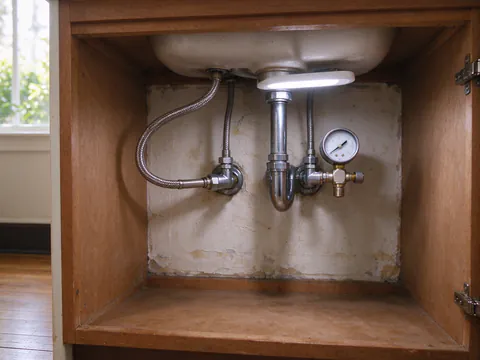
- Look where the supply pipe is exposed. A garage ceiling, basement or crawlspace, the line at the water heater, under sinks.
- Look for signs of a hidden leak. Damp or stained drywall, warm spots on a floor, a patch of wet ground between the sidewalk and the house.
Don’t open the meter box. SFPUC asks customers not to access meters, which only its field staff should handle, and it offers a courtesy site visit and a free Water-Wise Evaluation to help find where the water is going.
Got a leak alert you can't explain?
Leak detection traces the supply side from the meter box inward and separates a running fixture from a pipe leak.
What a small leak costs
A leak at exactly the alert threshold, 7.5 gallons an hour, running for a 30-day month, wastes 5,400 gallons, about 7.2 billing units of 100 cubic feet. San Francisco bills sewer service on metered water, so a leak costs twice. At SFPUC’s published single-family rates, which change each fiscal year, the marginal cost is about $43 per 1,000 gallons once water and wastewater charges are both counted, so that leak adds roughly $233 to a month’s bill. A larger leak scales from there. The cost of the water can be smaller than the cost of what a hidden leak does to framing, plaster and flooring over the same month.
Getting part of the bill back
SFPUC’s leak allowance is open to single-family, multifamily and non-residential accounts in San Francisco. It ordinarily credits:
- 50% of the excess water for a visible leak, such as a fixture or a toilet.
- 100% of the excess water for a concealed leak, underground or behind a wall.
The credit covers no more than two billing periods, including the one claimed. The application is due within 15 days of first noticing the high bill, the allowance is granted only after the repair is made, and proof is required: a plumber’s invoice, a receipt for materials, or an SFPUC inspection. Review can take up to four months, and repair costs are not reimbursed. Insurance is a separate question; the homeowners insurance guide explains why policies generally address sudden water damage rather than slow leaks or worn pipe.
Where the water is usually going
A continuous leak on the supply side can come from several places, and the alert doesn’t say which:
- Fixtures and appliances. Running toilets, dripping faucets, a failed washer or ice-maker connection.
- The water heater. A relief valve discharging, or a leaking tank or connection.
- Interior supply pipe. A pinhole in copper, a weeping threaded joint in galvanized, a failed fitting inside a wall. The copper pinhole leaks guide covers why copper develops them.
- The service line. The buried pipe from the meter box to the building is the owner’s, and a leak there can run for a long time with no sign indoors except the meter.
Drain leaks don’t trigger the alert, because drains carry water that has already passed the meter; the guide to whether repiping includes drain pipes explains the two systems. A water stain that appears only when a fixture above is used points to a drain, not the supply.
Finding a hidden leak
When the obvious checks come up empty, the leak is in a wall, under a floor or underground. Finding it starts at the meter box and the main valve, isolating the building from the service line to see which side the flow is on, then working inward through the system by sections and fixtures. The aim is the smallest opening in the right place. If the line is wet underground, water service line replacement may be the fix rather than a patch; if the house pipe is galvanized and leaking at joints, pipe repair handles the leak and the repipe vs repair guide covers whether to go further.
If water is visibly pouring, skip the diagnosis: close the main valve and follow the burst pipe guide. Emergency pipe repair is available 24/7 for a leak that can’t wait.
Daly City and South San Francisco
SFPUC’s alert and leak allowance apply to its retail accounts in San Francisco. Daly City runs its own water department, which will shut water off on request at any hour, and the city does not publish a leak credit comparable to SFPUC’s. South San Francisco is served by Cal Water’s Bayshore District, which is responsible only for the utility side of the meter, requires customers to repair leaks within five business days of being notified, and publishes a meter test: turn off all water in the house and watch the meter’s test hand for movement.
For a leak alert you can’t trace, call or send the form with what the hourly data shows, and the search starts at the meter box.