For most San Francisco repipes, PEX costs less and needs fewer wall openings, while copper is a rigid metal system with more joints and a higher price, usually somewhere from about 10% to 60% more for the same home. Both are approved by the California Plumbing Code, and San Francisco adds no restriction on either, so the choice turns on the building, the budget and what each material needs around it.
Hilltop Repipe San Francisco offers and manages repipes in both materials across San Francisco, Daly City and South San Francisco, with the work carried out by licensed and insured contractors. This guide sets the two side by side so the choice is made on facts rather than on habit. The PEX repiping and copper repiping pages describe each job in full.
What the code allows
Table 604.1 of the 2025 California Plumbing Code lists copper, PEX, CPVC and several other materials as approved for both building supply and water distribution. San Francisco adopts that code with local amendments, and a full search of those amendments finds none that restricts PEX, PE-RT or CPVC water piping. The local rules that do change a repipe are about valves, air chambers and dielectric fittings, and they apply whichever material is chosen.
Each material carries its own conditions. Copper tube must be at least Type L, with the thinner Type M allowed above ground in or on a building. All PEX installed in California must have at least 30-day UV protection, its joints must follow the maker’s instructions, and brass fittings used with it must resist dezincification. PEX-AL-PEX, the aluminum-layered version, is not adopted for drinking water in housing. The guide to whether PEX is allowed in California covers those state rules in detail.
What San Francisco permits show
DataSF publishes DBI’s plumbing permits. Among 273 permit descriptions from 2021 to 2025 that describe domestic water repiping, 92 name copper and only 6 name PEX. That count says more about how contractors have written permits than about which material performs better. More recent filings on PermitSF include a run of per-unit permits at one apartment building, mostly described as repiping water with PEX, which suggests the balance moves with building type.
Homeowners report being steered toward copper with reasons that don’t hold up, from rodents to daylight, and receiving quotes thousands of dollars apart for the same house. A written scope that names the material and explains why it fits the building is the way to separate a real constraint from a preference.
How each one travels through a building
The biggest practical difference is shape. PEX comes in long coils and bends around joists and up wall cavities, so a run from the garage to an upstairs bathroom may need a fitting only where it branches and where it ends. Copper is cut and joined at every change of direction. A route that needs a dozen joints in copper can need two in PEX, and each joint in a finished wall is a place that has to be reached.
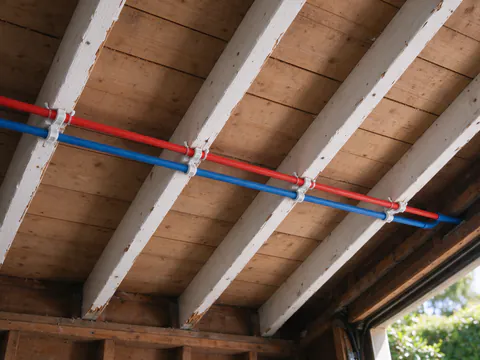
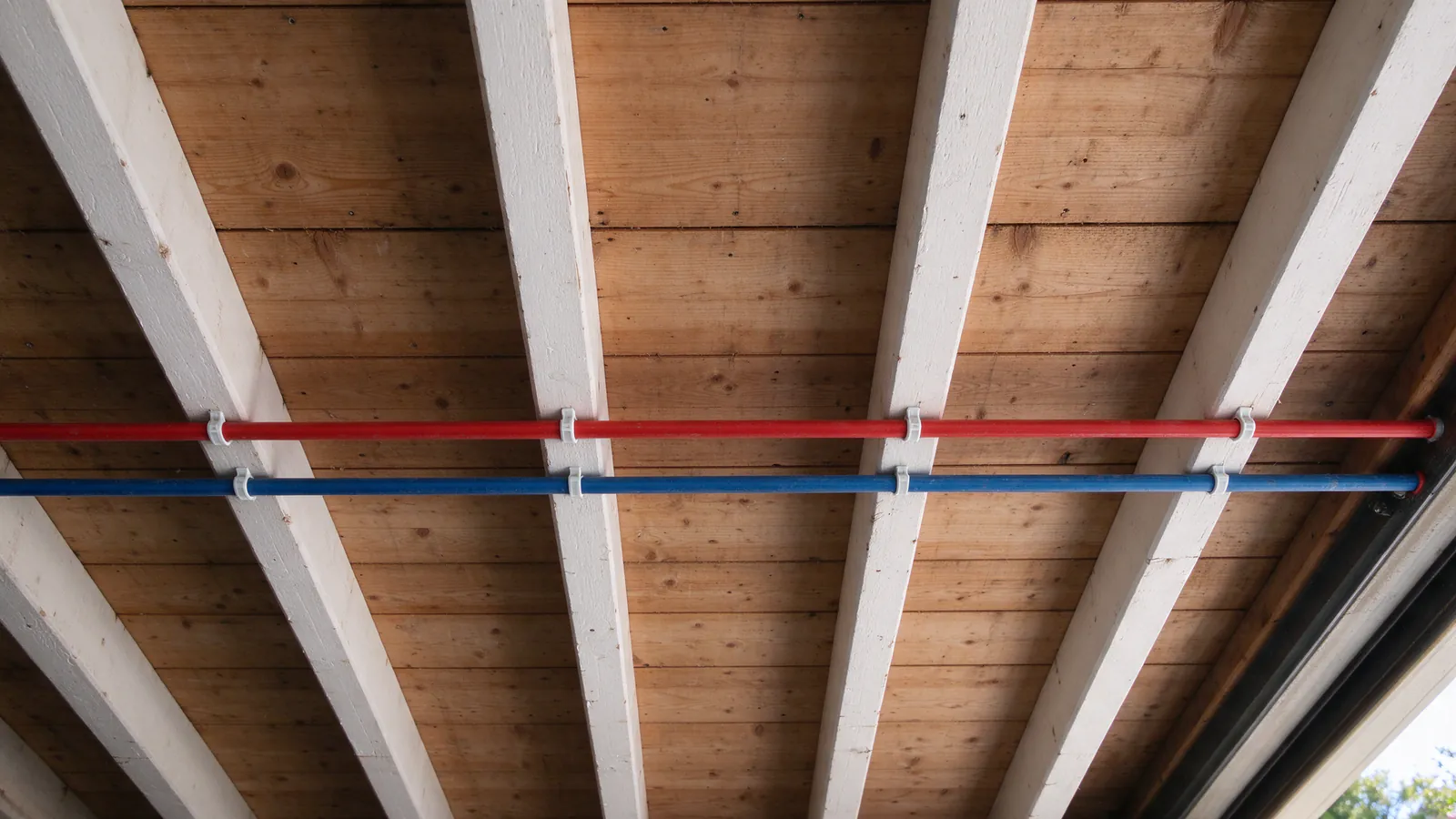
That is why PEX repipes usually open fewer walls. In a Sunset house with its trunk lines along an open garage ceiling, the difference is smaller, because the mains are exposed either way and only the climbs to each fixture group go through walls. In a two-story house with plaster upstairs, or in stacked flats where risers pass through other units, the ability to fish tubing through a cavity matters much more. The guide to how invasive repiping is shows where openings tend to land.
Layout follows the material. PEX can run trunk-and-branch like the old system, or home-run from a manifold with one line per fixture. Copper is almost always trunk-and-branch. The manifold vs trunk-and-branch guide compares them.
Cost
The published typical San Francisco-area ranges are for PEX: $8,500 to $16,000 for a one-bath house, $12,000 to $22,000 for two baths and $14,500 to $28,000 for three, with multi-story or hard-access homes running higher. Copper usually costs more for the same home, and sources put the premium anywhere from about 10% to 60%. That is a spread, not an average, and the gap is widest where copper’s extra joints mean extra openings.
Material prices push the same way. In the Bureau of Labor Statistics producer price index, copper and brass mill shapes rose about 30% over a recent twelve-month span, while plastic pipe rose about 4%. The repipe cost guide breaks down the rest of the price, and the cost estimator shows the range for either material.
San Francisco water and each material
SFPUC reports average hardness of 62 ppm, a pH of about 9.3 adjusted for corrosion control, and chloramine as the disinfectant. Soft, high-pH water does not build scale, and the utility’s corrosion control keeps metal leaching low: in SFPUC’s 2024 tap sampling, the 90th percentile for copper was 72 parts per billion against an action level of 1,300.
Chloramine is the variable worth asking about, and the guide to San Francisco water and your pipes covers the chemistry. It does not rule out either material, but rubber seals, gaskets and some fittings are rated by their makers for chlorinated and chloraminated water, and PEX tubing carries its own chlorine-resistance rating. For PEX in a continuously recirculating hot water loop, the state code requires tubing that meets ASTM F876-2015a or better. Copper failures, when they happen, have more than one possible cause, which the copper pinhole leaks guide explains.
South San Francisco is different. Cal Water blends local groundwater, with average hardness of 384 ppm, into its supply there, so mineral scale inside pipes and fixtures is a real factor in that city in a way it is not in San Francisco.
What has to change around each material
Exposure to heat and daylight
PEX has to be kept out of sunlight after installation and away from heat sources at the distances its maker sets. Garages with windows, runs near a gas water heater’s flue and attics with skylights are where copper or a protected section is often used instead. Copper has no daylight limit, but it is joined with heat or press tools and needs fire precautions when soldered inside an occupied building.
Electrical bonding
In many older houses the metal water pipe was part of the electrical grounding path. The California Plumbing Code requires replacement building supply to be like material where metal supply pipe serves as a grounding electrode, and the electrical code requires any remaining metal water piping to stay bonded. A PEX repipe therefore includes a check of the bonding by a licensed electrician. A copper repipe usually keeps the path intact.
Where new pipe meets old
Any old steel that stays, whether a short stub at the meter or a riser serving another unit, has to be joined to copper through a dielectric or insulating fitting, or a brass nipple at least 6 inches long, under San Francisco’s code. PEX connects to steel through listed transition fittings. In a partial repipe, the number of these transitions is part of the price.
Noise
Water hammer comes from quick-closing valves, not from the pipe. San Francisco requires air chambers at single-handle faucets, shower valves and similar valves regardless of material. Rigid copper can transmit the knock more audibly, and PEX needs proper support so it doesn’t move, so both depend on the installation.
Weighing PEX against copper for your building?
A walk-through looks at the route, exposure and old pipe that stays, then names the material in a written scope.
Side by side
| Question | PEX | Copper |
|---|---|---|
| Code status | Listed in CPC Table 604.1; 30-day UV protection required in California | Listed in CPC Table 604.1; Type L, or Type M above ground where allowed |
| How it is joined | Expansion, crimp or clamp fittings from one listed system | Soldered, brazed or press-fit fittings |
| Openings | Usually fewer, because tubing bends through cavities | Usually more, at every elbow and tee |
| Typical cost | The basis of the published San Francisco-area ranges | Usually higher, by about 10% to 60% for the same home |
| Exposure limits | Daylight and heat sources, per the maker | None for daylight; heat precautions when soldering |
| Electrical bonding | Must be checked where metal pipe was the path | Usually unchanged |
| Watch for | Support spacing, fittings rated for chloramine | Dielectric transitions, joint workmanship |
Making the choice
Copper tends to fit when the route is open, exposure to daylight or heat is unavoidable, the owner prefers metal, or the budget allows for it. PEX tends to fit when walls are finished, especially plaster, when lines have to climb several floors or when cost matters most. Many jobs mix them. What matters more than the label is that the scope names the fitting system, the layout, the transitions to any old pipe and the bonding check. The PEX-A vs PEX-B guide covers the choice within PEX, and the repipe vs repair guide covers whether a full repipe is the right scope in the first place.
To talk through PEX and copper for a specific building, call or send the form. The walk-through starts at the meter and ends with a written scope that names the material and the reason for it.