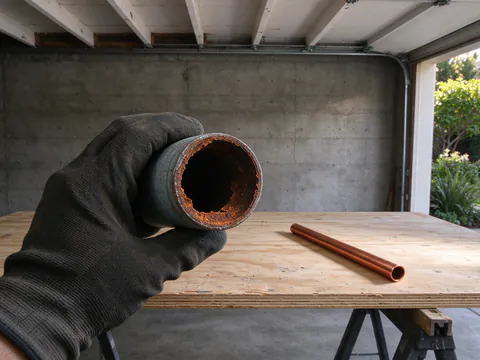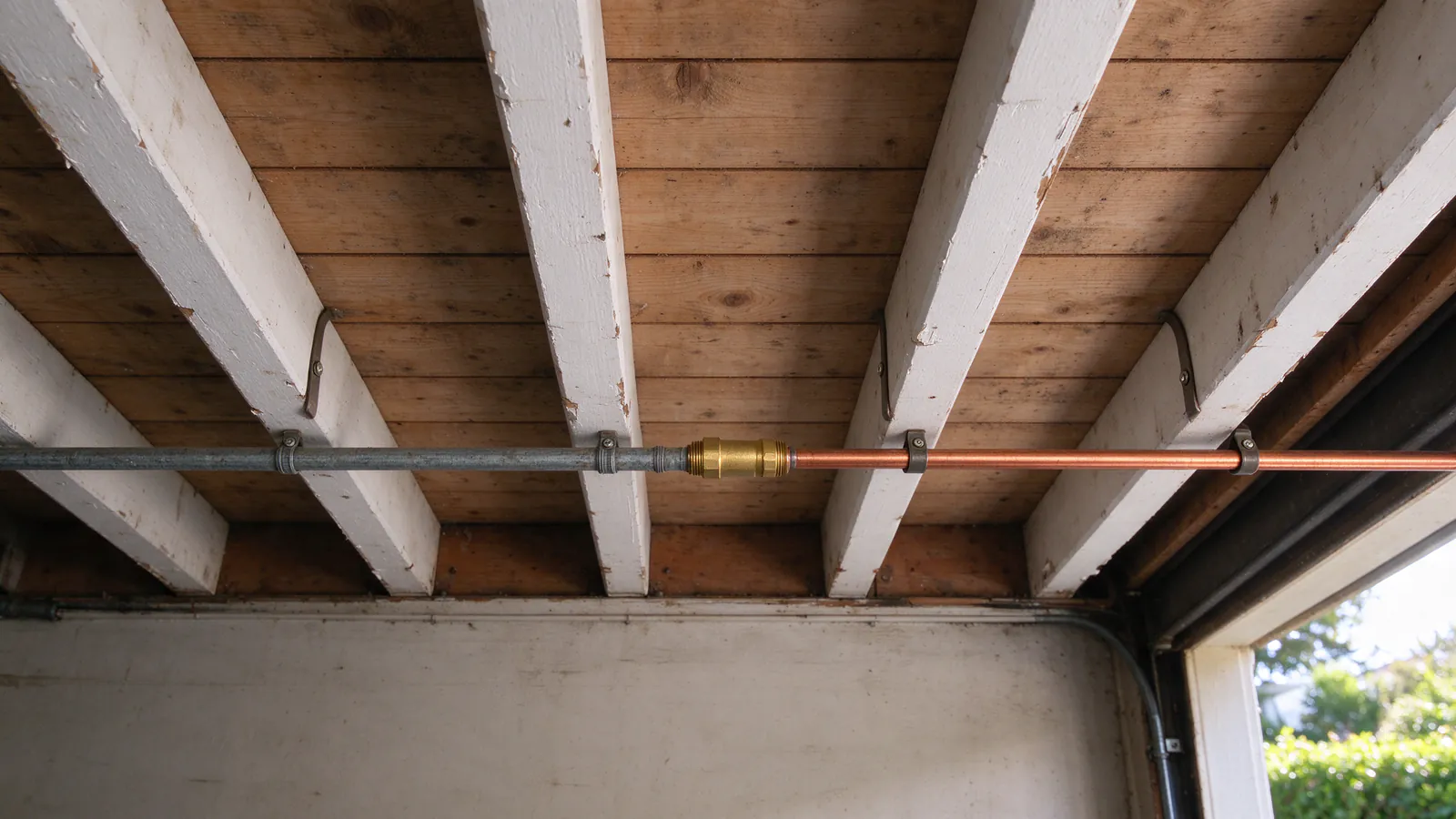
The quickest test is a magnet: it sticks to galvanized steel and to nothing else in a water system. Galvanized pipe is dull gray, joined with threaded fittings, and often shows rust at the threads. Check the exposed pipe at the garage ceiling, basement, crawlspace or water heater, because San Francisco buildings often hold galvanized, copper and plastic in different places.
Hilltop Repipe San Francisco manages galvanized pipe replacement and repiping across San Francisco, Daly City and South San Francisco, with the work carried out by licensed and insured contractors. This guide shows how to identify each material yourself and what each one means for the decisions ahead. Look and touch only; there is no need to cut, open or test anything.
Where to look in a San Francisco building
Supply pipe is easiest to see where it is exposed. In many Sunset and Parkside houses, that is the garage ceiling, where the line from the street, the main valve, the water heater and the trunk lines often hang in plain view. In flats, look at the basement or garage under the building and at the water heater. Under kitchen and bathroom sinks, the short pipe coming out of the wall behind the stop valve shows what the branch inside the wall is made of.
Start where the water enters. SFPUC says most main shutoffs are on the outside of the house or just inside, in line with the water meter at the sidewalk, and some supplies enter through a tank in the garage, basement or closet. The meter box itself is SFPUC’s, and SFPUC asks owners not to open it. The pipe you can see between the wall and the main valve is usually the end of the owner’s service line, covered on the water service line replacement page.
Galvanized steel
Galvanized pipe is threaded steel coated with zinc. Signs to look for:
- Color. Dull silver-gray, darker with age, sometimes painted.
- Joints. Threaded fittings with visible threads where pipe enters each elbow, tee and union. Rust or a white crust often shows at the threads.
- Magnet. A magnet sticks firmly.
- Sound. Tapped with a coin, it rings duller and heavier than copper.
San Francisco has a lot of it. The U.S. Census Bureau counts 45.2% of the city’s housing units as built in 1939 or earlier, and among 273 DataSF permit descriptions from 2021 to 2025 that describe a water repipe, 76 name galvanized. A galvanized service line or main also tells you something about the rest: the guide to whether galvanized pipes are safe covers what it means for the water, and the low water pressure guide covers what it does to flow.
Copper
Copper tube is reddish brown when clean, darker brown with age and green where it has oxidized. Joints are smooth sleeves sealed with solder, often with a silver line at each edge, or pressed fittings with a ring-shaped bulge. A magnet does not stick. Copper tube is often printed with a colored stripe: blue for Type L and red for the thinner Type M. California’s code requires Type L for water distribution, with Type M allowed above ground in or on a building. Green crust at many joints, or a history of pinholes, says more about a copper system’s condition than its age; the copper pinhole leaks guide covers it.
Plastic systems: PEX, CPVC and polybutylene
PEX
PEX is flexible tubing that bends around corners, usually red for hot, blue for cold or white for either. It is printed every foot or so with its name, its standard and its maker. Joints use crimp or clamp rings, or a fitting the tube has been stretched over. PEX in a building usually marks a recent repair or repipe; the PEX vs copper guide compares the two main materials.
CPVC: how to recognize it and when it is replaced
CPVC is rigid plastic pipe, usually cream, tan or off-white, joined with glued fittings that show a smear of solvent cement at the joint. It is printed with “CPVC” and its standard. It does not bend. No DataSF repipe description from 2021 to 2025 names CPVC, so it is not a common San Francisco material. When it turns up, the question is its age and condition: older CPVC can become brittle, and a cracked fitting near a water heater or behind a wall is the usual reason it gets replaced. California lets building officials permit new CPVC inside homes only under extra flushing and worker-safety conditions, which is one reason replacements use PEX or copper.
Polybutylene
Polybutylene is flexible tubing, usually gray but sometimes blue or black, often stamped PB2110. It was used mainly in the 1980s and early 1990s and is associated with fitting and pipe failures. It is rare here: none of the 273 San Francisco repipe permit descriptions mention it, and most of the city’s housing was built long before it was used. If it is found, it is replaced as a whole system.
Lead
Lead pipe is dull gray, softer than steel and often joined with rounded, bulb-shaped joints. A magnet does not stick, and scratching the surface gently with a coin or key leaves a bright, shiny silver mark. Copper scratched the same way shows copper color, and galvanized stays dull.
In San Francisco, lead pipe on the owner’s side is unlikely. SFPUC removed all known lead service lines, about 7,000, in the 1980s, estimates a 1% chance of lead in customer-owned lines and says its plumbers have never observed one. SFPUC’s map at sfpuc.gov/Lead shows addresses where utility- or customer-owned galvanized lines were identified. Anyone who finds pipe that looks like lead should ask SFPUC to inspect it and test the water. The lead pipes in San Francisco guide covers the program.
Drain pipe is a different system
Large gray or black pipes running down walls and through the floor are usually drains: cast iron, galvanized drain pipe or black ABS plastic. They carry used water out by gravity and are not part of a supply repipe. The guide to whether repiping includes drain pipes explains the boundary.
| Material | Color | Joints | Magnet | What it usually means |
|---|---|---|---|---|
| Galvanized steel | Dull gray | Threaded | Sticks | Original or early pipe; check flow, rust and leaks at threads |
| Copper | Reddish brown or green | Soldered or pressed | No | Later replacement or original in newer houses; check joints and leak history |
| PEX | Red, blue or white | Crimp, clamp or expansion | No | Recent repair or repipe |
| CPVC | Cream, tan or off-white | Glued | No | Uncommon in San Francisco; check age and brittleness |
| Polybutylene | Gray, blue or black | Crimp rings | No | Rare here; replaced as a system |
| Lead | Dull gray, shiny when scratched | Rounded, bulb-like | No | Never observed on an SF owner’s side; report it to SFPUC |
What you see is not the whole system
Most older buildings hold more than one material, because each leak was fixed with whatever was standard that year. Copper at the water heater and galvanized in the walls is a common combination; so is a copper bathroom from a remodel fed by a galvanized riser. Where copper meets galvanized, San Francisco now requires a dielectric fitting or a brass nipple at least 6 inches long, and older splices without one tend to leak at that joint first.
That is why a walk-through traces each run from the meter to the fixtures, notes the material of every riser and branch it can see, and measures static pressure, before anyone recommends a partial repipe or a whole-house repipe. Inspection reports at sale often name galvanized; the guide to buying a house with galvanized pipes covers what to do with that.
Found galvanized, or not sure what you found?
Describe the pipe you can see at the garage ceiling or water heater, and a walk-through traces the rest from the meter.
If you have identified galvanized or a mix of materials and want to know what it means for your building, call or send the form, and the walk-through will map the rest.