A whole-house PEX repipe in the San Francisco area typically costs $8,500 to $16,000 for one bath, $12,000 to $22,000 for two baths and $14,500 to $28,000 for three; multi-story or hard-access homes can run higher, and copper usually costs more. These are typical San Francisco-area budgeting ranges, not quotes. Hilltop Repipe San Francisco gives a written scope and price for a building only after a walk-through, and the whole-house repiping page describes what that scope covers.
Typical ranges for a San Francisco repipe
| Work | Typical range | What it usually covers |
|---|---|---|
| Whole-house PEX repipe, 1 bath | $8,500 to $16,000 | New hot and cold supply lines from the main valve to each fixture, fittings, valves, testing and reconnection |
| Whole-house PEX repipe, 2 baths | $12,000 to $22,000 | The same scope across more fixtures and longer runs |
| Whole-house PEX repipe, 3 baths | $14,500 to $28,000 | The same; multi-story or hard-access homes can run higher |
| Whole-house copper repipe | Usually higher than PEX | Sources put the premium anywhere from about 10% to 60% for the same home |
| Customer-side water service line | $2,000 to $6,000 (national budgeting range) | The owner’s pipe from the meter box to the building; long runs, trenchless work or hardscape run higher, and San Francisco permits are on top |
| Heat pump water heater replacing a gas tank | $5,500 to $8,000 (typical San Francisco-area range) | A typical single-family conversion; larger tanks, closet rebuilds, long circuit runs or panel work can run higher |
| Gas tank water heater, like for like | $2,200 to $4,300 (typical Bay Area range) | Replacement with permit, straps and haul-away; power venting, relocation or venting changes cost more |
A partial repipe, a single condo unit and a multi-unit building have no published local range that holds up, so they are priced from the same drivers below. For a building, the apartment building repiping page explains how per-unit permits and riser access change the math.
PEX and copper ranges
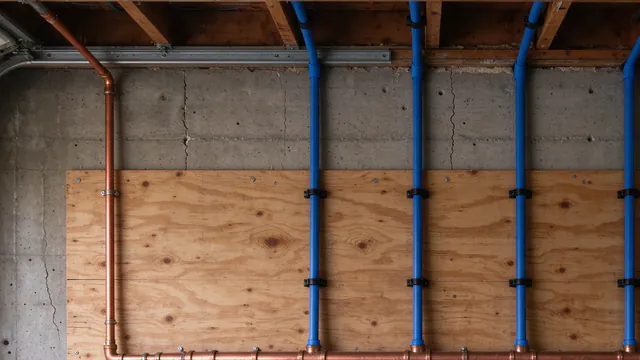
The published ranges are for PEX because that is where current local price evidence is strong enough to publish a band. Copper is still the material most San Francisco repipe permits name, so its price matters just as much. PEX comes in long coils that bend through joists and up wall cavities, so a run that needs a dozen fittings in copper may need two in PEX, and fewer openings follow. Copper is cut and joined at every turn, which takes more labor and usually more access.
Material cost pulls the same way. In the Bureau of Labor Statistics producer price index, copper and brass mill shapes rose about 30% over a recent twelve-month span, while plastic pipe rose about 4%. Sources still disagree widely on how big the finished-job gap is, from about 10% to about 60% for the same house, and that spread is reported as it is rather than averaged. The PEX vs copper guide covers the choice beyond price.
What’s inside a San Francisco repipe price
Part of every repipe quote rests on figures anyone can check. The rest depends on the building and is worth asking about line by line.
| Part of the price | What sets it | Local figure |
|---|---|---|
| Labor | Hours to map, route, join, test and reconnect; the billed rate also carries insurance, licensing, vehicles and overhead | Plumbers in the San Francisco-Oakland-Fremont metro earn a mean $44.41 an hour and a median $37.44, against $34.70 and $30.67 nationally (BLS) |
| Plumbing permit | DBI category by unit count and whether underground work is included | $549 for a house without underground work, $809 with it; a separate permit for each condo or apartment unit; $259 per half hour of re-inspection (San Francisco DBI) |
| Valves the city requires | SF Plumbing Code 606.2, 606.3 and 606.5: a main valve, a shutoff for each dwelling unit, a control valve at each fixture | No public price; count the valves in the scope |
| Air chambers | SF Plumbing Code 609.11: at single-handle faucets, shower valves, solenoid valves and flushometers | No public price; part of the fixture count |
| Dielectric fittings | SF Plumbing Code 604.1: insulating fittings or 6-inch brass nipples where copper meets steel | No public price; more of them in a partial repipe |
| Pressure regulator and expansion tank | California Plumbing Code 608.2: required where static pressure exceeds 80 psi | No public price; only if measured pressure calls for it |
| Water heater straps | California Plumbing Code 507.2 and Health and Safety Code 19211: straps in the upper and lower thirds | No public price; a code item when missing |
| Lead-safe setup | Paint in pre-1979 buildings is presumed to contain lead; SF Existing Building Code Section 327 sets containment, notice and cleanup | No public price; penalties run up to $500 per violation per day |
| Asbestos sampling | Air district Regulation 11 Rule 2: sampling before disturbing textured or skim-coated walls in buildings of four or fewer units | No public price; scope to check in older interiors |
| Sidewalk excavation | San Francisco Public Works excavation permit if a service-line trench opens the public sidewalk | About $802 for a small project (Public Works fee schedule) |
| Electrical bonding | Electrical code 250.104: remaining metal water pipe must stay bonded when plastic replaces metal | No public price; an electrician confirms, possibly under a separate permit |
| Wall and ceiling restoration | Number of openings, plaster or drywall, texture, tile, paint | No public figure; the biggest swing between quotes |
The wage gap explains part of the local premium. Plumbers in the San Francisco metro earn a mean $44.41 an hour, about 28% above the $34.70 national mean, and a median $37.44 against $30.67. A wage is not a billing rate, though: the hourly price on a quote also covers insurance, licensing, vehicles, permits and overhead, so the gap in billed rates is not the same number.
What moves the price
| Factor | Toward the low end | Toward the high end |
|---|---|---|
| Size and fixtures | One bath, a compact kitchen, few outlets | Several baths, a laundry, a wet bar, outdoor faucets |
| Stories | One living floor over an open garage | Two or three stories with stacked baths |
| Access | Mains on an open garage ceiling, basement or crawlspace | Finished ground floor, no crawlspace, flat roof with no attic |
| Wall finishes | Drywall, few openings, owner paints | Original plaster and lath (old-house repiping), tile walls, cabinets to pull |
| Material and layout | PEX, trunk-and-branch | Copper, or a home-run manifold with many lines |
| Building | Single-family, owner-occupied | Flats or apartments with occupied units, per-unit permits and staged shutoffs |
| Code items | Valves and straps already compliant | Regulator, expansion tank, new straps, many air chambers |
| Service line | Owner’s line already copper | Galvanized line from the meter box replaced at the same time |
| Restoration | Basic patching only | Texture match, plaster repair and painting in the quote |
Stories, stacked flats and garage-level mains
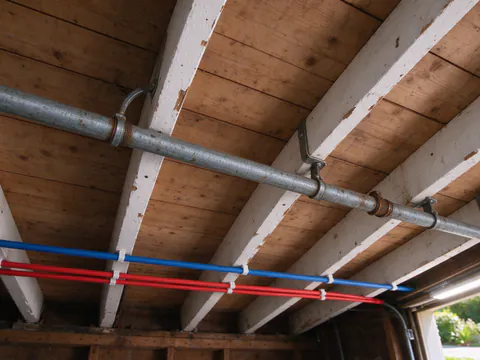
A two-story house costs more to repipe than a one-story house with the same fixture count, because each line to an upper floor has to climb through a wall or chase, and every climb is an opening. In San Francisco the comparison often runs the other way from what people expect: a Sunset house with one living floor over an open garage can be among the easier jobs in the city, because the trunk lines run exposed along the garage ceiling. The Sunset and Parkside page covers those houses. Stacked flats share risers, so replacing one unit’s lines can mean working in the units above or below, and each unit needs its own shutoffs and permit. The guide to how invasive repiping is shows where openings tend to land.
Want a number for your building?
A walk-through turns these ranges into a written scope: material, openings, permit and price.
Permit fees
San Francisco’s Department of Building Inspection prices plumbing permits by category, and the permit is filed by a licensed contractor on PermitSF. Daly City and South San Francisco have their own building divisions and fee schedules.
| Permit | Fee | Notes |
|---|---|---|
| San Francisco 1P, single residential unit | $290 | Water service, sewer replacement or a single fixture, kitchen or bath remodel; two inspections |
| San Francisco 2PA, six or fewer units, no underground work | $549 | Up to three inspections |
| San Francisco 2PB, six or fewer units, with underground work | $809 | Up to four inspections; applies when buried pipe is included |
| San Francisco 3PA, 7 to 12 units | $1,045 | Up to five inspections |
| San Francisco 3PB, 13 to 36 units | $2,104 | Up to eight inspections |
| San Francisco 3PC, more than 36 units | $8,679 | Up to 30 inspections |
| San Francisco re-inspection | $259 per half hour | Charged when an inspection fails or an extra one is needed |
| San Francisco off-hours inspection | $555 per hour | Two- or four-hour minimums |
| Daly City plumbing permit | $101 issuance, plus $56.50 per water piping item and $14 per fixture | Unit fees under the City of Daly City master fee schedule |
| South San Francisco plumbing permit | Priced per trade by job valuation | The Building Division sets the path for a repipe; confirmed per project |
DBI requires a separate permit for each condominium unit and each existing apartment unit, so permit costs multiply in a building. Which category DBI assigns to a particular house, and whether the service line is on the same permit, is confirmed when the permit is filed. The San Francisco repiping permit guide covers the process.
Incentives and programs
No grant or rebate pays for an interior repipe in San Francisco, repiping does not qualify for a federal tax credit, and homeowners insurance generally covers sudden water damage under the policy’s terms rather than planned replacement. A few programs touch the work around it.
| Program | Who runs it | What it offers | Conditions |
|---|---|---|---|
| Utility-side service line replacement | SFPUC | Replaces the utility’s galvanized line from the main to the meter at no direct charge | Does not cover the owner’s line or any interior pipe |
| Customer-side line inspection and lead test | SFPUC | Free lead test and inspection for owners who received a galvanized-line letter (lead pipes in San Francisco) | No money toward replacing the owner’s line |
| Lead test | SFPUC | $25 per tap | Free for WIC participants |
| Electrify Your Home bill credits | CleanPowerSF (SFPUC) | $1,200 in bill credits ($50 a month for 24 months) for a heat pump water heater replacing a gas or electric-resistance unit | Active CleanPowerSF customers in San Francisco, an electrification rate, an ENERGY STAR model, a licensed contractor and a permit in good standing |
| Home Upgrade rebate | WestLight Energy | $3,500 for a heat pump water heater replacing a gas, propane or oil unit | Daly City and South San Francisco electricity accounts; apply within 90 days of installation |
| Rehabilitation loans | Mayor’s Office of Housing and Community Development | Loans for code and health and safety repairs for income-qualified owner-occupants of 1 to 4 unit buildings | Offered when funded; check the office for current status |
Owners of rental buildings have one more cost question. The Rent Board can certify new piping as a capital improvement after the work is finished. In a building of one to five units, the certified cost is amortized over 20 years and all of it can pass through, capped at 5% of base rent (or $30, whichever is greater) in any 12 months. In a building of six or more units, the period is 10 years and generally half the cost passes through, capped at 10% (or $30). Certification is the Rent Board’s decision, and the capital improvement guide explains the rules.
Two budget examples (illustrative)
These are illustrative only, built from the published ranges and agency fees above. They are not quotes for any house.
A one-bath Sunset house over an open garage, PEX. The repipe itself falls in the typical one-bath range of $8,500 to $16,000, toward the lower half if the mains are on an open garage ceiling and the walls upstairs are drywall. The DBI permit is $549 if the quote does not already include it. If the owner’s line from the meter box is galvanized and replaced at the same time, a national budgeting range for that work is $2,000 to $6,000, and the permit moves to the $809 category with underground work. Patching and painting the openings is a separate line to check.
A two-bath, two-story house with plaster walls, copper. Start from the two-bath PEX range of $12,000 to $22,000 and expect the climbs to the second floor and the plaster to push toward the top. Copper usually lands above that, by a margin sources put anywhere from about 10% to 60%. If the house was built before 1979, lead-safe setup adds time at every opening. If the gas water heater is replaced with a heat pump unit in the same visit, a typical San Francisco-area range is $5,500 to $8,000, and an eligible CleanPowerSF customer may receive $1,200 in bill credits over 24 months.
What a quote should list
Two quotes for the same house can be thousands apart because they describe different jobs. Before comparing totals, check that each one names the material and fitting system, the layout, every fixture and outdoor faucet, the valves and air chambers the city requires, whether the pressure was measured and a regulator is included, the water heater connections, whether the service line is in or out, the permit category, and each opening with who patches it and how far. A quote that leaves restoration out can look cheaper and end up costing more, and one that leaves the schedule vague says little about the time the job takes. The quote comparison checklist lays these out on one page, and the repipe vs repair guide covers whether a full repipe is the right scope at all.
For a number for your own building without a phone call, the repipe cost estimator applies these ranges to the baths, floors and material you choose. For a written price, call or send the form, and the walk-through starts at the meter.