Low water pressure in San Francisco usually comes from inside the property, not from the street: galvanized pipe narrowed by its own rust, a partly closed or failing valve, a pressure-reducing valve that has drifted, or clogged aerators and cartridges. Street pressure does vary, because the city is served through about 13 pressure zones, so the first step is to measure static pressure at the front of the building.
Hilltop Repipe San Francisco diagnoses and fixes pressure problems that come from supply piping, from galvanized pipe replacement to valve and regulator work, across San Francisco, Daly City and South San Francisco, with the work carried out by licensed and insured contractors. This guide walks through the causes in order, from the street to the faucet, and covers what happens when pressure is too high.
Pressure vs flow
Two different things get called water pressure. Static pressure is the force in the pipe when nothing is running, measured in psi with a gauge. Flow is how much water actually reaches a fixture when it is open, measured in gallons a minute. A house can have normal static pressure and poor flow, which is the classic sign of a restriction between the meter and the fixture. It can also have low static pressure everywhere, which points upstream.
A shower that weakens when a toilet flushes, or a kitchen tap that drops to a trickle when the washer fills, is a flow problem. The pipe cannot carry enough water for two fixtures at once.
How pressure and flow are tested
A good assessment measures before it recommends anything:
- Static pressure with a gauge threaded onto the hose bibb nearest the meter, with every fixture off. That gives the number the street and service line deliver.
- Pressure downstream of any regulator, if the building has one, to see what it is passing.
- Flow at fixtures, timing how fast a container fills at a tub spout or laundry tap, one fixture at a time and then two at once.
- Hot vs cold at the same fixture. Low hot with normal cold points to the water heater or its connections, not the house piping.
- Valves from the main to each fixture, checked for full opening. Old gate valves can seize partly closed or lose their gate inside.
Each step narrows the list. Static pressure that is normal at the front and poor flow at the back of the house, on both hot and cold, points to the pipe in between.
Where low pressure comes from
The street and the pressure zone
SFPUC serves the city through about 13 pressure zones, fed from 12 reservoirs and six tanks at different elevations. SFPUC publishes no customer pressure range, and pressure at one address says little about the next. A house high in its zone, near the level of the reservoir that feeds it, may see lower static pressure than one at the bottom of the same hill. That is a reason to measure, not a diagnosis. If static pressure is low at the meter, new pipe inside will not raise it.
The service line
The pipe from the meter box to the building is the owner’s, and the guide to whether galvanized pipes are safe covers why SFPUC has been replacing galvanized lines. Where that line is old galvanized, it can be the narrowest pipe on the property. SFPUC has been replacing its own galvanized lines on the utility side with copper, and it has written to owners whose side it identified as galvanized. A narrowed service line starves the whole house at once. The water service line replacement page covers it.
The main valve and other valves
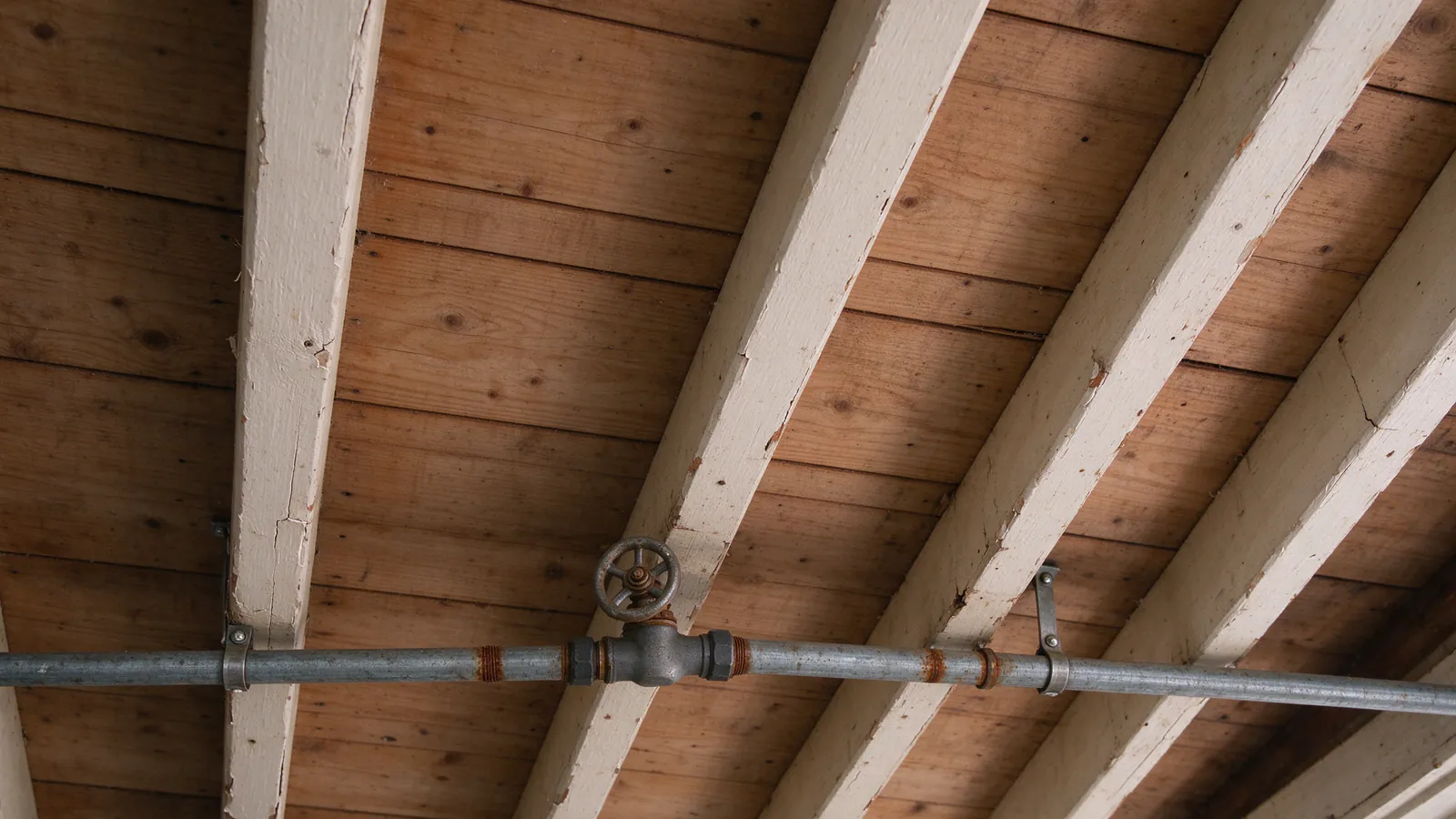
An old gate valve that is partly closed, or whose gate has broken loose inside, restricts every fixture downstream. Valves in the line to one bathroom or one unit do the same for that area. They are cheap to check and sometimes the whole answer.
The pipe inside the walls
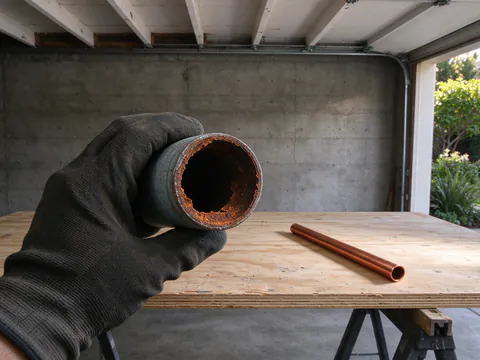
Galvanized pipe rusts from the inside once its zinc coating wears through. In hard-water cities, mineral scale adds to the narrowing. San Francisco’s water is soft (San Francisco water and your pipes has the figures), with average hardness of 62 ppm, so a galvanized line that loses flow here is usually clogged by its own corrosion products. The narrowing is worst on long runs and small branches, so the fixtures farthest from the main, often an upstairs shower, fail first. The guide to identifying pipe material shows how to tell whether you have it.
South San Francisco is the exception in this area. Cal Water blends groundwater with average hardness of 384 ppm into its supply there, so mineral scale inside pipes and fixtures is a real cause in that city.
Fixtures and the water heater
Aerators, showerheads and valve cartridges have fine passages that catch rust and sediment, especially right after plumbing work or a utility shutoff has stirred up old pipe. Low hot water alone usually traces to the water heater: a partly closed inlet valve, sediment or its connections, covered on the water heater replacement page. Brown water that comes with the low pressure is covered in the rusty water guide.
Flats and apartment buildings
In a building where several units share risers, pressure at one unit depends on what the others are using. San Francisco’s code requires a shutoff for each unit, which makes it possible to work on one unit’s lines, but a riser narrowed by rust limits every unit it serves. The apartment building repiping page covers shared risers.
Checking the pressure-reducing valve
A pressure-reducing valve, also called a pressure regulator or PRV, sits after the main valve where street pressure is high and lowers it to a set level for the building. California requires regulators to comply with ASSE 1003 or AWWA C530, to be preceded by a strainer that can be cleaned without removing the regulator, and to be accessible above ground.
Regulators wear. A failing one can drift low, starving the building, or creep high, letting street pressure through. Its strainer can clog with rust from old pipe, which looks exactly like a pipe restriction. Checking the outlet pressure against the street side, and cleaning the strainer, is a quick step before anyone talks about pipe.
When pressure is too high
Too much pressure is a problem too. The 2025 California Plumbing Code says that where static pressure in the building’s water piping exceeds 80 psi, an approved regulator preceded by a strainer must be installed and static pressure reduced to 80 psi or less. An approved expansion tank must go in the cold water piping downstream of each regulator, so that heated water expanding in the tank cannot push pressure back above 80 psi; a system designed by a licensed plumbing contractor may use relief valves set no higher than 100 psi instead.
High pressure stresses every joint, valve and appliance. Signs include banging when a valve closes, toilets that keep refilling, a water heater relief valve that drips and faucets that wear quickly. San Francisco also requires air chambers at quick-closing valves such as single-handle faucets and shower valves, which cushion the surge. Because the city publishes no pressure range, a repipe that measures more than 80 psi at the start adds a regulator and expansion tank to its scope.
Pressure that swings
Pressure that rises and falls on its own has a short list of usual causes. A regulator that is failing can hunt between settings. A building with a regulator, check valve or backflow assembly is a closed system: when the water heater heats, the expanding water has nowhere to go, and pressure climbs until a fixture opens. The code requires an expansion tank on such systems for that reason, and San Francisco requires a backflow assembly near the meter for buildings four or more stories tall. In flats, swings that track a neighbor’s shower point to a shared riser that is too narrow.
Weak showers, or a gauge reading over 80?
A walk-through measures static pressure and flow first, then puts the cause and the fix in writing.
When old pipe is the cause, and what fixes it
If static pressure at the meter is normal, the valves are open, the regulator checks out and flow still falls off across the house, the pipe is the restriction. In San Francisco that usually means galvanized. Replacing it restores flow because the new pipe has its full bore. The choice is between a partial repipe of the worst runs and a whole-house repipe; the repipe vs repair guide covers that decision. A typical San Francisco-area range for a whole-house PEX repipe is $8,500 to $16,000 for one bath, $12,000 to $22,000 for two and $14,500 to $28,000 for three, and a regulator and expansion tank are added where measured pressure calls for them.
A repipe will not fix low pressure from the street, and it will not fix a clogged aerator. That is why the gauge goes on first. For a pressure and flow check on your building, call or send the form.