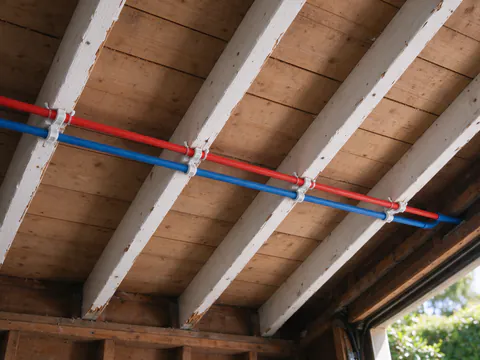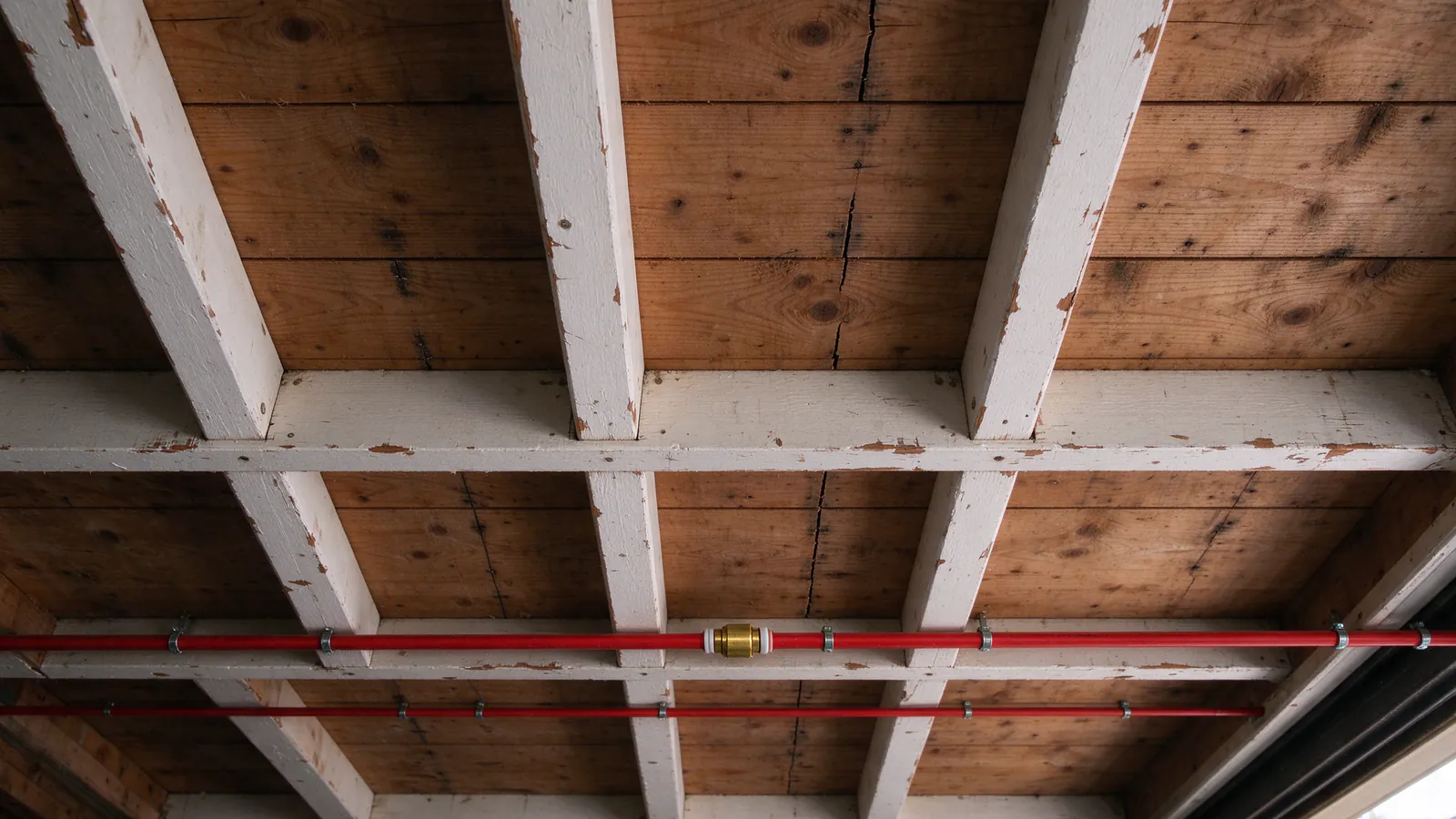
PEX-A and PEX-B are both crosslinked polyethylene tubing approved for drinking water in California, and both work for a repipe. The practical differences are that PEX-A is more flexible and is usually joined with expansion fittings, while PEX-B is stiffer, usually cheaper and joined with crimp or clamp rings. The fitting system matters as much as the letter.
Hilltop Repipe San Francisco manages PEX repiping across San Francisco, Daly City and South San Francisco, with the work carried out by licensed and insured contractors, and the scope for each job names the tubing and fitting system. This guide explains what those names mean so you can read a quote, compare two of them and ask the right question about either.
What the letters mean
PEX is polyethylene whose molecules have been crosslinked, bonded to one another, so the tubing holds its shape and strength under hot water and pressure. The letter describes the method. PEX-A is crosslinked while the tube is being formed, which leaves it more evenly crosslinked and more elastic. PEX-B is crosslinked after it is formed, through a chemical and moisture cure, which leaves it stiffer. A third type, PEX-C, is crosslinked with radiation and is less common in repipes.
The letter is not a quality grade. All three are made to the same family of standards for tubing used in hot and cold water distribution, and each tube is printed with its standard, its pressure and temperature ratings, and its maker. What the letter changes is how the tube behaves when it is bent and which fittings it takes.
Fitting systems: expansion, crimp and clamp
How the tube is joined is the difference installers notice most, and it is the part of a quote that deserves a question.
Expansion fittings
With an expansion system, a tool stretches the end of the tube and a reinforcing ring, the fitting is pushed in, and the tube shrinks back over it within seconds. Because the tube grips the fitting by its own memory, there is no separate crimped band. Expansion fittings are built for PEX-A and sit inside a stretched tube, so the opening through the fitting is close to the tube’s own bore. That keeps the flow loss at each fitting low, which is why expansion systems are often chosen for long runs and home-run manifolds where every fixture line has several fittings.
Crimp and clamp fittings
Crimp and clamp systems slide a ring over the tube, insert a barbed fitting and compress the ring with a tool. Copper crimp rings are squeezed evenly around the tube; stainless clamp or cinch rings are pinched at one tab. The fitting sits inside the tube without stretching it, so its bore is smaller than the tube’s. Crimp fittings work on PEX-A and PEX-B and are the usual way PEX-B is joined. Each ring has to be checked with a go/no-go gauge or the tool’s own check, because a ring that is not fully closed can hold for months before weeping.
Push-fit fittings
Push-fit fittings seal with an internal O-ring and grip with a toothed ring. California’s code requires them to comply with ASSE 1061. They are handy for a repair in a tight space but are rarely used for a whole system.
Whatever the system, the 2025 California Plumbing Code requires PEX joints to be made to the manufacturer’s instructions, fittings to be listed in Table 604.1, and brass fittings used with PEX to meet NSF/ANSI 14 so they resist dezincification. That is why a repipe uses tubing and fittings from one system the maker lists together.
Flexibility and kinks in old buildings
PEX-A bends more tightly and springs back more readily. If it kinks, many makers allow the kink to be repaired with heat, because the material returns toward its original shape. PEX-B holds a bend less willingly and a kink is generally cut out and joined with a coupling.
In a San Francisco building that difference has a real effect. Pulling tubing up a plaster wall between studs, around fire blocking, or through a floor into the unit above in stacked flats is easier with tubing that bends tightly without kinking. In a Sunset house where the mains run along an open garage ceiling, stiffer tubing that lies straight between hangers is easy to work with and the difference shrinks. The guide to how invasive repiping is shows where tubing has to climb, and the old-house repiping page covers plaster-and-lath interiors.
Freezing, sunlight and chlorine
Freeze tolerance is often listed as PEX-A’s advantage, since expanding ice is less likely to split a more elastic tube. NOAA’s normals for downtown San Francisco record no nights at or below freezing in an average year, so it carries little weight here.
Sunlight matters for both. All PEX installed in California must have at least 30-day UV protection, and makers set how long the tubing may be exposed before it is covered. Neither type belongs in a garage window’s sunlight or on a roof without protection.
Chlorine resistance is rated by the maker for each product, and SFPUC’s water is disinfected with chloramine. For PEX in a continuously recirculating hot water loop, the state code requires tubing that meets ASTM F876-2015a or better. Ask which rating the chosen tubing carries if the building has or will have recirculation. The guide to San Francisco water and your pipes covers chloramine.
Reading a PEX repipe quote?
A written scope names the tubing, the fitting system and the layout, so two quotes can be compared line by line.
Side by side
| Question | PEX-A | PEX-B |
|---|---|---|
| How it is made | Crosslinked during forming | Crosslinked after forming |
| Feel | More flexible, tighter bends | Stiffer, holds straight runs |
| Usual fittings | Expansion; crimp also possible | Crimp or clamp rings |
| Flow through fittings | Expansion fittings keep the bore close to the tube’s | Insert fittings narrow the bore slightly |
| Kinks | Many makers allow heat repair | Cut out and coupled |
| Material and tool cost | Usually higher | Usually lower |
| California rules | 30-day UV protection, joints per maker, fittings per Table 604.1 | The same |
Does the choice change the price?
On a whole-house repipe, not much. PEX-A tubing and expansion tools usually cost more than PEX-B and crimp tools, but the price of a San Francisco repipe is mostly labor, access, the valves and air chambers the city requires, the permit and patching. The typical San Francisco-area range for a whole-house PEX repipe is $8,500 to $16,000 for one bath, $12,000 to $22,000 for two and $14,500 to $28,000 for three, with multi-story or hard-access homes running higher. Those ranges apply to PEX in general, not to one type. The repipe cost guide covers what actually moves the number.
Where the difference can matter more is in a home-run manifold layout, which has many separate lines and many fittings, and in buildings where the route is tight enough that fewer kinks mean fewer openings. The manifold vs trunk-and-branch guide covers layout.
What to ask about either
- Which tubing, which fitting system and which maker lists them together?
- Where does the PEX change to metal: at the water heater, the meter-side valve, any old pipe that stays?
- How is the tubing protected from daylight and heat until and after it is covered?
- Is the tubing rated for chloraminated water and, if there is a recirculation loop, for continuous hot water circulation?
- How is each crimp or expansion joint checked before the pressure test?
The broader material question is covered in the PEX vs copper guide, and the whole-house repiping page describes the full scope. For a scope that names the tubing and fittings for your building, call or send the form.