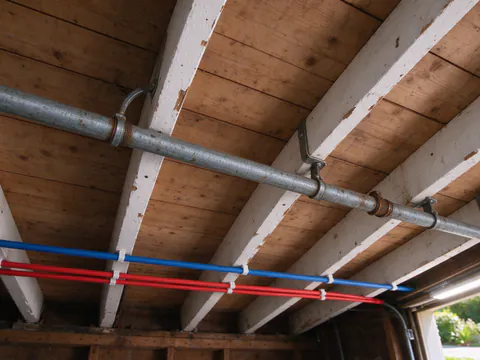
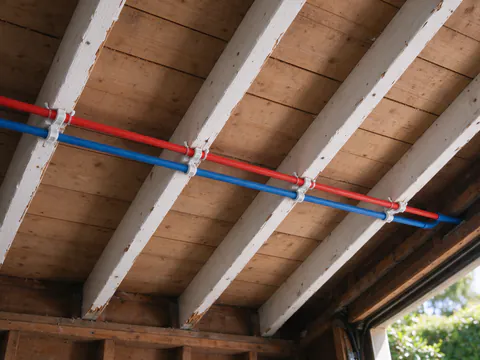
Stand in a Sunset garage and look up, and you can often see the whole water system of the house: the line from the sidewalk, the main valve, the water heater and the trunk lines running toward the kitchen and bathroom overhead. Hilltop Repipe San Francisco replaces supply piping in the Sunset, Parkside and the neighboring west and southwest districts, from whole-house repipes to galvanized pipe replacement, with the work carried out by licensed and insured contractors under a DBI permit.
That garage ceiling is the reason this part of the city gets its own page. It changes where the new pipe goes, how many walls are opened and what a repipe disrupts.
Why the garage ceiling changes the job
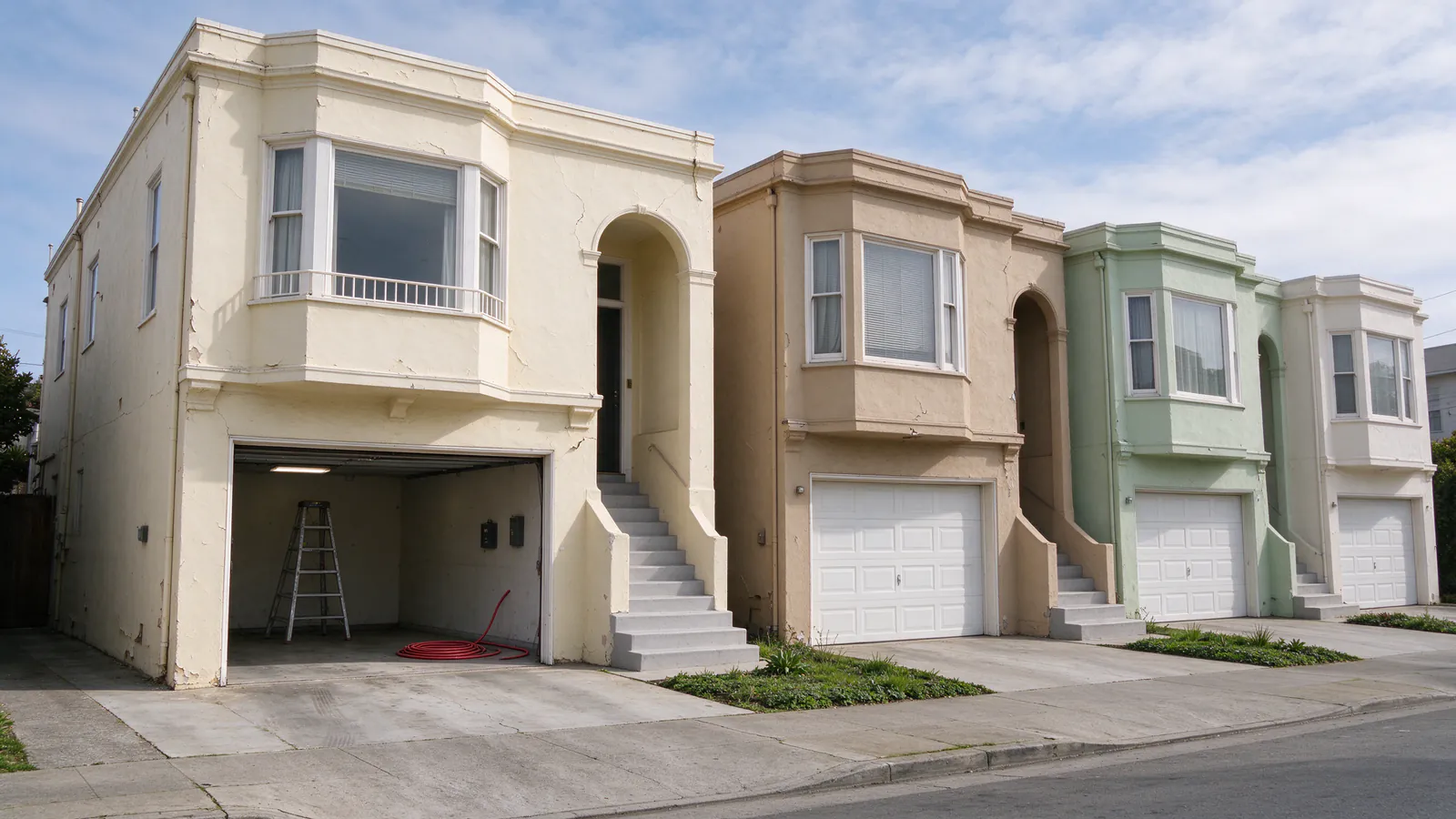
San Francisco Planning’s context statement on Sunset District builders of 1925 to 1950 describes houses with the garage built into the ground story, “which typically resulted in living spaces located above the ground-story garage.” It calls the one-story-over-garage format characteristic of the Sunset, with no known examples outside San Francisco except, later, Daly City. Ground stories varied: some held only the garage, others a laundry or finished rooms.
Where a house follows that pattern, the main supply lines usually hang from the garage ceiling, below the floor of the living space. A repipe can replace that trunk from below, working on open joists, and bring each branch up through the floor to the fixture it serves. Openings upstairs are then limited to where a line has to climb into a wall: behind the kitchen sink, at the bathroom group, at a laundry. The garage also becomes the staging area, which keeps tools and cut pipe out of the rooms people are living in. Where the ground story has been finished into a room, that advantage shrinks, and the ceiling has to be opened and patched like any other.
What the housing numbers say
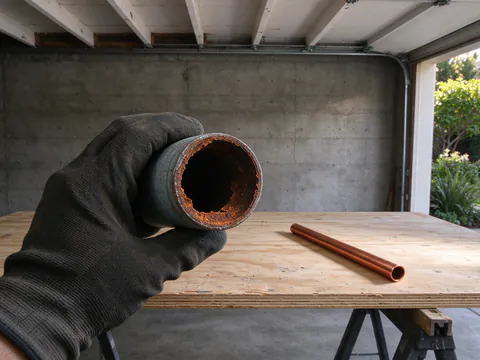
In the Census Bureau’s ZIP area that covers most of the Sunset, 45.9% of housing units were built in 1939 or earlier and another 29.0% between 1940 and 1959. Half are single-unit buildings and 30.0% are in buildings of two to four units. In the area that covers Parkside, 84.7% of units are single-unit buildings and 50.4% were built between 1940 and 1959. Those dates span the galvanized-steel era and the first years of copper, so a Sunset house can hold either, or both where earlier leaks were patched. Housing age is context, not a diagnosis: only tracing the pipe in a particular house says what is in it.
How a Sunset job usually runs
The walk-through starts at the meter box at the sidewalk and the main valve, which in most houses sits where the supply enters, in line with the meter, and measures static pressure. The city has about 13 pressure zones fed from reservoirs and tanks at different elevations, and the Sunset runs from the ocean flats up to Golden Gate Heights, so pressure is measured at each address rather than assumed. Then the trunk is traced across the garage ceiling to each riser, the fixtures are counted, and the walls upstairs are noted as plaster, drywall or tile.
The written scope names PEX or copper, the layout, each opening and the permit. During the work, new lines are run alongside the old ones, then each fixture group is switched over, so water is off in stages. The water heater, often standing in the garage, is reconnected with a valve on its cold supply and straps in the upper and lower thirds. The system is pressure tested, the city inspector sees it, and the openings are closed. The guide to how invasive repiping is shows what those openings look like.
Where the street meets the house
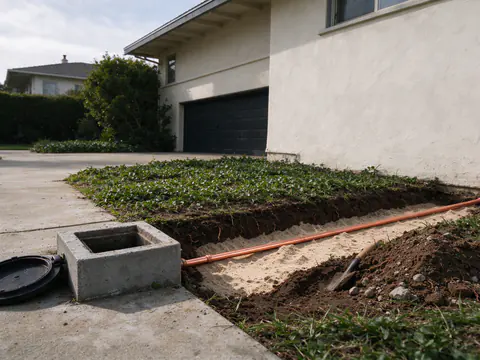
The meter box belongs to SFPUC, and so does the line from the water main to it. SFPUC has been replacing its galvanized lines with copper and has written to owners whose own side, from the meter box to the house, it identified as galvanized. Where both sides were replaced at different times, a short run of old steel sits between new copper at the sidewalk and whatever is inside. Replacing that owner’s line during the repipe means the new system is not fed through rusted pipe. The water service line replacement page covers it, and the guide to whether galvanized pipes are safe covers water quality questions.
Permits on the record
DataSF publishes DBI’s plumbing permits. Among permits filed from 2021 to 2025 whose descriptions name domestic water repiping, Sunset/Parkside and the Inner Sunset account for 66, among the highest of any group of neighborhoods in the city, and 120 over 2016 to 2025. Many permits list only a work code with no description, so the real number is higher. The count shows where documented repipe work happens; it does not say anything about the condition of a given house. The San Francisco repiping permit guide covers the steps.
West of Twin Peaks
West Portal, St. Francis Wood, Forest Hill, Miraloma Park and the streets around them form a heavily owner-occupied, single-family district. In the Census ZIP area covering them, 90.6% of housing units are single-unit buildings, 52.7% were built in 1939 or earlier, 29.2% between 1940 and 1959, and only 17.1% are rented. DBI records 25 repipe permits there from 2021 to 2025. A repipe here is an owner’s decision about their own house, without the tenancy rules that shape the job in flats. Houses tend to be larger and more varied than in the Sunset tracts, so the climbs to upstairs bathrooms and the plaster around them often decide the route more than any garage ceiling does. Old-house repiping covers plaster-and-lath interiors.
Excelsior and the Outer Mission
The Excelsior, Outer Mission, Crocker-Amazon, Ingleside, Oceanview and Merced Heights add 36 more documented repipe permits from 2021 to 2025. In the Census ZIP area covering most of them, 81.2% of units are single-unit buildings, 49.2% were built in 1939 or earlier and 27.0% between 1940 and 1959. The decision looks much like the Sunset’s: a single-family house of the galvanized era, an owner deciding between a partial and a whole-house job. No planning study documents a building form for these streets the way the Sunset’s does, so where a house has its mains in a ground-floor garage or a crawlspace, the route follows that; where it doesn’t, the walk-through finds the most open route available. The partial repiping page covers jobs that stop at one floor or bathroom group.
Repiping a house in the Sunset or Parkside?
Say whether the garage ceiling is open or finished and how many baths are upstairs. The route and the openings come back in a written scope.
Flats in the Sunset
Not every Sunset building is a single house. Three in ten units in the Sunset’s ZIP area sit in buildings of two to four units, and roughly half of the area’s homes are rented. In those buildings, San Francisco code requires that each unit’s hot and cold water can be shut off without cutting water to the others, and the Rent Board’s rules apply if a unit would have to be vacated during the work. The apartment building repiping page covers stacked units and shared risers.
What it costs here
Prices in the Sunset follow the same typical San Francisco-area ranges as the rest of the city: $8,500 to $16,000 for a one-bath whole-house PEX repipe, $12,000 to $22,000 for two baths and $14,500 to $28,000 for three, with multi-story or hard-access homes running higher and copper usually costing more. The repipe cost guide explains the drivers, and the cost estimator gives a range in a minute.