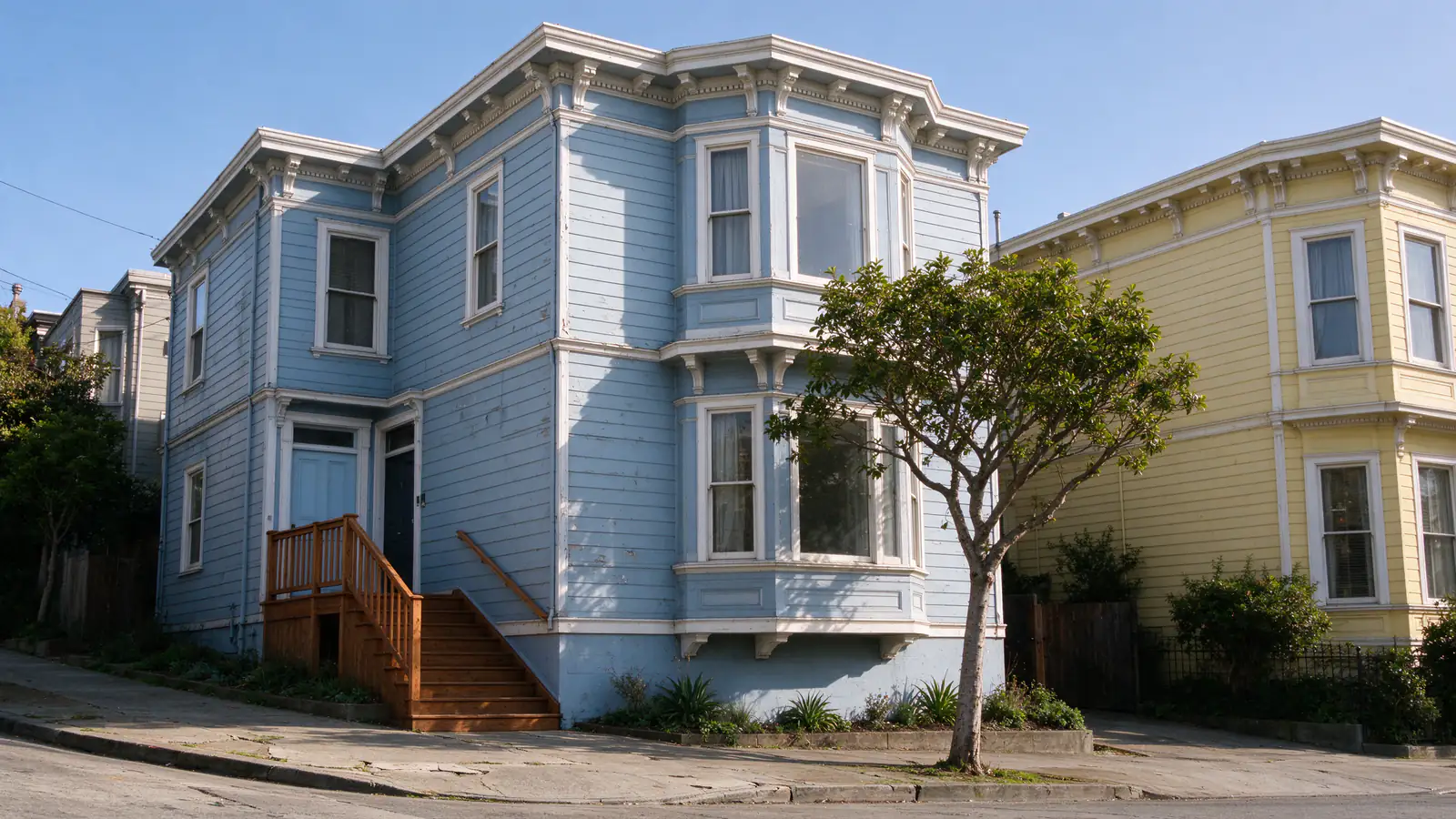
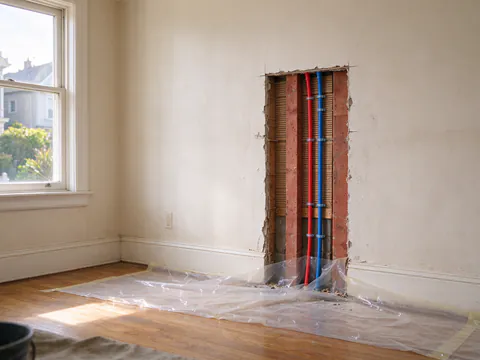
A repipe in a Mission or Noe Valley flats building has to answer a question a single-family job never faces: how each household keeps running water while the pipes behind its walls are replaced. Hilltop Repipe San Francisco offers and manages repiping for flats buildings and houses across the Mission, Noe Valley, the Castro, Bernal Heights and the Haight, from apartment building repiping of a whole stack to partial repiping of one unit, with the work carried out by licensed and insured contractors under DBI permits.
These neighborhoods share a building type. In the Census Bureau’s ZIP areas covering the Mission and Bernal Heights, the Castro and Noe Valley, and the Haight and Cole Valley, 61% to 70% of housing units were built in 1939 or earlier, 37% to 41% sit in buildings of two to four units, and between 55% and 71% are rented. Old pipe, small buildings and tenants in place: that combination shapes a repipe here.
Water for every flat while the work goes on
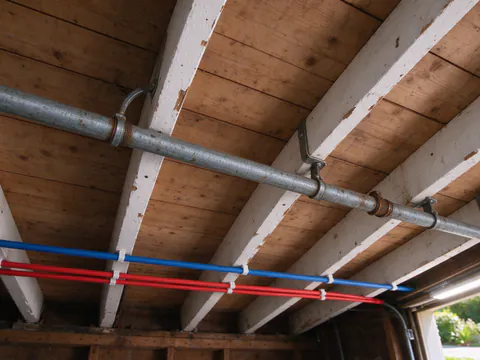
In an occupied building, the schedule matters as much as the pipe. New lines are run alongside the old ones, then each flat or fixture group is switched over in turn, so water goes off in stages. Where a basement or ground-floor garage exposes the mains, the new trunk can be built and tested there before any flat loses water. The risers take the most planning: each one feeds a kitchen or bathroom stack in every unit above it, so its changeover is arranged with every household on that stack.
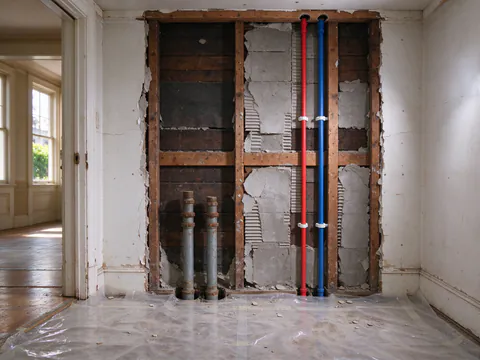
The written scope says which flats lose water on which days. Keeping each unit habitable, with water back on each evening, also keeps the project out of the Rent Board’s temporary eviction process described below. The guide to how invasive repiping is shows the openings involved, and the guide to how long repiping takes covers the schedule.
One shutoff per flat, and a valve at every fixture
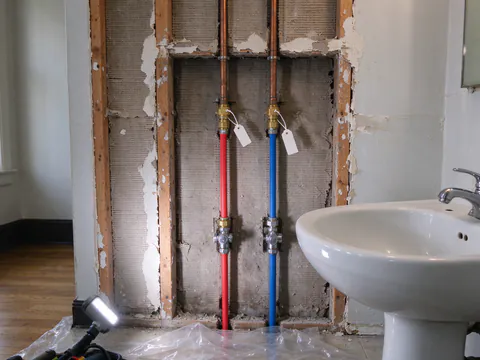
San Francisco amends the state plumbing code in ways that matter most in flats. Section 606.3 requires one or more shutoff valves in each dwelling unit, placed so the hot and cold supply to any unit can be shut off without cutting water to another. Section 606.5 requires a control valve ahead of each fixture’s hot and cold supply. Section 606.2 requires a valve on each water heater’s cold supply and, where one heater serves several units, valves that let each unit’s hot water be shut off on its own. Under 606.3.1, any unit where a remodel is performed has to be brought up to those rules.
Many older flats predate all of this: one main valve, and no way to isolate a single flat when the top unit leaks. A repipe is the natural moment to add the valves, because the lines that need them are already open. The old-house repiping page covers pre-war construction, and the whole-house repiping page lists what a full repipe includes.
How stacked flats are usually piped
No city study documents the piping layout of these buildings, so the walk-through traces it. Where kitchens and bathrooms are stacked floor above floor, the supply rises in a few vertical runs from a main below, and new risers can follow the same chases, so openings line up instead of scattering through every room. Where flats were added or rearranged later, the piping follows the remodel, and copper, galvanized and newer plastic can all turn up in one building. Where new copper meets steel that stays in service, San Francisco’s Section 604.1 requires a dielectric or insulating fitting, or a brass nipple at least 6 inches long, at the joint. The guide to identifying pipe material explains what to look for, and galvanized pipe replacement covers the steel itself.
Permits for a building of flats
In DBI’s permit data on DataSF, 68 permits filed from 2021 to 2025 in these neighborhoods, Glen Park and Potrero Hill describe domestic water repiping, 15 of them in Bernal Heights. Many permits list only a work code, so the true number is higher.
For residential buildings of six or fewer units, DBI’s plumbing fee is $549, or $809 when the work includes underground plumbing. DBI also requires a separate permit for each existing apartment unit, so a building of flats carries more than one permit and more than one fee, with the categories settled when the licensed contractor files on PermitSF. Every permit needs its inspections before walls close, and a failed or extra inspection costs $259 per half hour. The San Francisco repiping permit guide walks through filing.
If a flat has to be empty for the work
Sometimes a unit cannot stay livable during the work, for example when the kitchen and the only bathroom are opened at once. The Rent Ordinance then allows a temporary eviction for capital improvements under Section 37.9(a)(11), but only if the unit would be hazardous, unhealthy or uninhabitable while the work is under way. The landlord must have the permits before serving notice, the notice must include copies of them and an approximate date for moving back, and a tenant cannot be required to stay out of the unit for more than three months unless the Rent Board extends it.
Relocation payments apply when a tenant is out of the unit for 20 days or more: under the Rent Board’s current schedule, which resets each March, $8,245 per tenant, up to $24,733 per unit, plus $5,497 for each tenant who is 60 or older or disabled, or each household with minor children. Shorter displacements fall under California Civil Code 1947.9 at a daily rate, currently $446. A repipe that restores water every evening avoids this process, which is why the phasing plan comes first. Owners should confirm their situation with the Rent Board or counsel.
Repiping a building of flats?
Say how many units, which are occupied and where the water heaters are. The phasing plan and the permits come back in a written scope.
Recovering the cost from rent-controlled units
A repipe can qualify as a capital improvement, which lets a landlord petition the Rent Board, after the work, to pass part of the certified cost through to tenants of the building. In buildings of one to five units, new plumbing is amortized over 20 years, the full certified cost may pass through, and the yearly increase is capped at the greater of $30 or 5% of base rent. Repairs do not qualify, and the Rent Board decides. The petition relies on itemized invoices and bids, so keep them from the start. The guide to whether repiping is a capital improvement covers the petition.
Paint, plaster and the three-day notice
San Francisco presumes paint in buildings built before 1979 contains lead unless a certified inspector shows otherwise, and Section 327 of the city’s Existing Building Code sets work practices when that paint is disturbed. For a rented flat or a shared hallway, that means plastic containment, restricted access, wet cleaning with HEPA vacuuming, a “Lead Work in Progress” sign and written notice to occupants at least three business days before work starts. Interior work in an owner-occupied unit is exempt from the interior rules, though dust may not migrate into common areas.
The Bay Area Air Quality Management District adds a second check: in residential buildings of four or fewer units, its asbestos rule requires sampling only when certain materials will be disturbed, textured or skim-coated walls among them. A flat with skim-coated plaster can need a sample before the first wall opens.
The Richmond District
The Inner and Outer Richmond, Laurel Heights, Presidio Heights and Lone Mountain sit between the flats belt and the single-family west side. In the Census ZIP areas covering them, 55% to 57% of units were built in 1939 or earlier, 36% to 40% are in buildings of two to four units and 26% to 38% are single-unit buildings. DBI records 28 repipe permits there from 2021 to 2025, half in the Outer Richmond. The right approach depends on the building, not the neighborhood: a Richmond building of flats follows everything on this page, while a single-family house there plans more like a Sunset repipe.
Prices for a flat and for the building
For a single-family house here, the typical San Francisco-area figures for a whole-house PEX repipe hold: $8,500 to $16,000 with one bath, $12,000 to $22,000 with two, $14,500 to $28,000 with three. Multi-story or hard-access homes can run higher, and copper usually costs more. A building of flats is priced from its own scope, not a per-unit formula: units and risers, occupied flats and the phasing they need, per-unit permits, code valves, lead-safe setup and patching. The repipe cost guide explains each driver, and the cost estimator gives a range for a house in a minute.