Gas line repiping replaces the gas piping a property owner is responsible for: the pipe that runs from the outlet of the PG&E meter to the shutoff at each appliance. Hilltop Repipe San Francisco offers and manages gas line repiping and gas pipe replacement across San Francisco, Daly City and South San Francisco, with the work carried out by licensed and insured contractors who hold the C-36 or C-4 license a San Francisco plumbing permit requires and pull the permit for the address.
Gas work is separate from water piping even when both happen in the same house. It has its own test, its own inspection steps and a hand-off to PG&E at the end, and the house is without gas until that hand-off is complete. If you smell gas now, this page is not the first step: leave the building and call 9-1-1, then PG&E; water emergencies are covered under emergency pipe repair.
What happens on the first visit
The walk-through starts at the gas meter and works out to every appliance: furnace or wall heaters, water heater, range, dryer, fireplace and any outdoor line to a grill or heater. The route of the existing pipe is traced and its material noted, whether black steel, galvanized steel outside, or flexible CSST in later work. Each appliance’s demand is compared with the size of the pipe that feeds it, because a line that was fine for the original appliances can be too small for a new range or a tankless water heater.
The owner is asked what is changing. Gas piping is often replaced because an appliance is being added, moved or taken out, or because walls are already open for a remodel, and a house moving its water heating or cooking to electric may need less gas pipe, not more. The result is a written scope and price that names the route, the material, the openings, the permit and the steps before PG&E restores service. The guide to how invasive repiping is shows what openings look like when pipe runs inside finished walls.
Who owns what: the meter and your piping
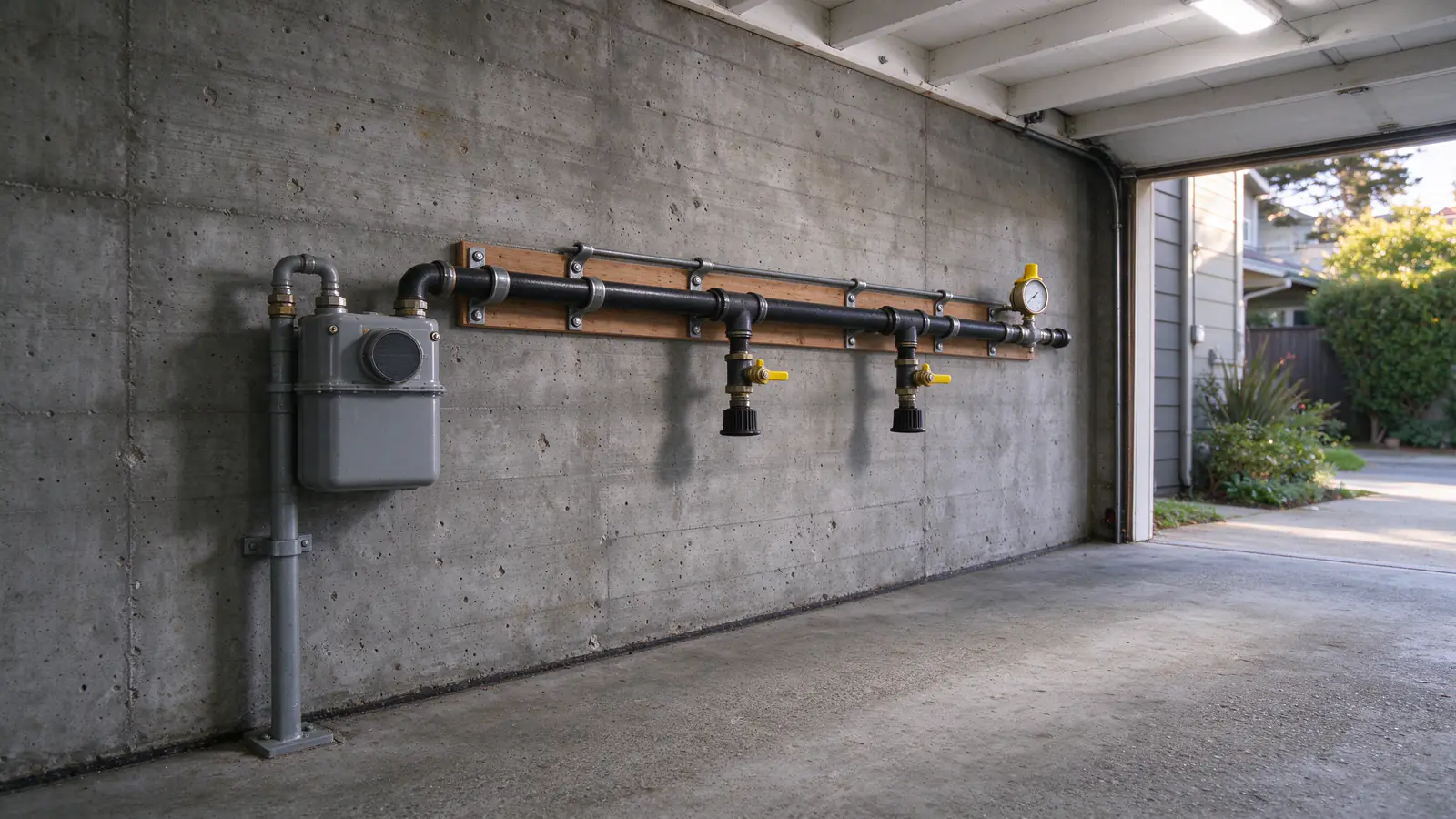
PG&E installs the service shutoff valve at every meter and owns the meter set. No attachments are allowed on its equipment. Everything downstream of the meter and its service tee is customer-side piping, under the city’s jurisdiction and the owner’s responsibility, much as the water line from the meter box is (see water service line replacement). That split decides the sequence. The gas is shut off at the meter, the customer-side work is done, the city inspects it, and PG&E turns the gas back on.
Gas lines in San Francisco can also run through places that are hard to see. During the city’s mandatory soft-story retrofit program, DBI and PG&E reviewed gas lines that had been encased in concrete in new foundations. Where a building has had a seismic retrofit, the gas route through the ground floor is checked before a new one is planned. In flats and apartment buildings, the apartment building repiping page covers the per-unit permits that also apply to gas work.
Materials, and San Francisco’s outdoor rule
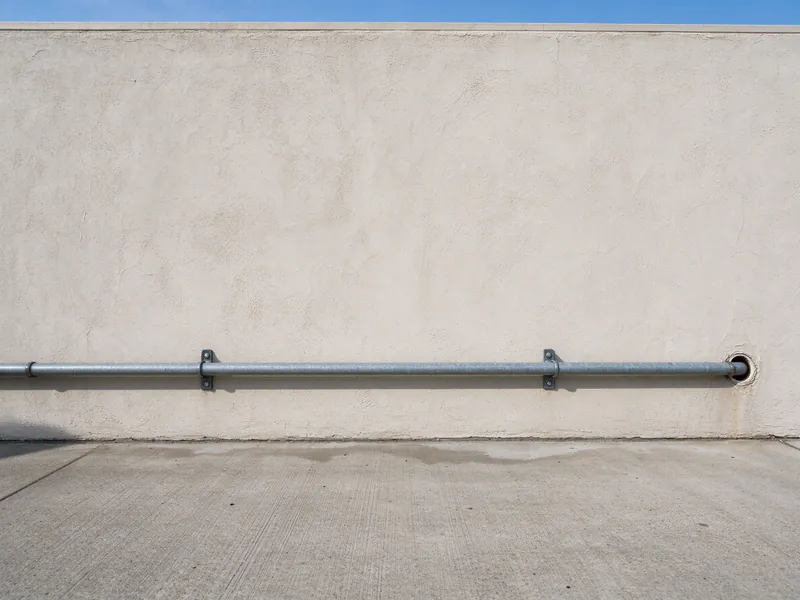
San Francisco amended the plumbing code so that gas piping in exterior locations is galvanized iron or steel with galvanized fittings. Runs along an outside wall, to a meter on the exterior, or across a yard to an outdoor appliance are built that way. Inside, the material follows the California Plumbing Code and the pipe’s listing.
CSST, the flexible corrugated stainless tubing, carries its own requirement: the system has to be electrically continuous and bonded to the building’s grounding electrode system with a copper jumper no smaller than 6 AWG and no longer than 75 feet, using listed devices. That is electrical work, so the scope flags it for a licensed electrician where CSST is used.
The pressure test and the inspector
A gas repipe has two inspections. The rough piping inspection happens before anything is concealed, while every joint can still be seen. Then the piping is tested with air, carbon dioxide or nitrogen at no less than 10 psi, held for at least 15 minutes with no drop, in the presence of the inspector. Welded piping, or a system carrying gas above 14 inches of water column, is tested at 60 psi for 30 minutes; CSST at those higher pressures is tested at 30 psi for 30 minutes. Final inspection follows once the appliances are connected.
The gas test is a different test from the water-line test on a whole-house repipe: different medium, different pressure, and witnessed by the city rather than only recorded. A test that fails means finding the leak, repairing it and testing again, with a re-inspection charged at $259 per half hour.
Changing appliances?
Say which gas appliances stay, which go electric and which are new. Branches that are no longer needed can be capped rather than rebuilt.
Why PG&E turns the gas back on
After the final inspection, the city issues a certificate and a copy goes to the gas supplier. State code makes it unlawful for the supplier to turn on gas or set a meter until that certificate has been issued, and only the gas supplier may turn on service that has been off. DBI’s fees must be paid before the “gas tags” that signal approval. City permit records show the pattern: dozens of recent descriptions mention gas tags or PG&E, such as a gas pressure test done so PG&E could reinstall service.
In practice the house is without gas for heat, hot water and cooking from the shutoff until PG&E restores it. PG&E’s crews restore service and relight pilots with someone present. Planning meals and hot water around that gap is part of planning the job.
Permits in San Francisco, Daly City and South San Francisco
In San Francisco, DBI’s plumbing permits cover gas piping. A gas line repair in a single residential unit is usually Category 1P at $290; residential work in buildings of six or fewer units without underground plumbing, covering water, gas, waste and vent, is Category 2PA at $549. Gas appliance work is permitted separately on the mechanical side, Category 1M at $290 for a single unit. City records show 178 residential permit descriptions for gas line replacement or repipes over a recent two-year span. The gas line permit guide walks through the steps.
Daly City lists a “Gas Pipe Repair” permit type. Its fees are $101 to issue a plumbing permit plus $14 for each gas piping system of one to four outlets and $14 for each outlet beyond that, so a four-outlet system comes to about $115. South San Francisco prices plumbing permits per trade by job valuation and requires a city business license for anyone paid for permitted work. The Daly City and South San Francisco pages cover both cities.
All-electric rules and existing gas lines
San Francisco has required new buildings to be all-electric since permit applications filed on June 1, 2021, so a new building has no gas piping to repipe. Since July 1, 2026, a Major Renovation of an existing building must also be all-electric, but only when two things are both true: the project is a significant alteration, and it replaces space and water heating for the entire building or installs new systems serving 80% or more of its conditioned floor area. Repairing or replacing existing gas piping does not meet that definition on its own, so on the city’s stated criteria San Francisco does not ban gas line repair or replacement in existing buildings. DBI decides how the rule applies to a particular project. South San Francisco’s all-electric reach code covers new residential construction, and Daly City’s adopted requirement is reported to cover new buildings as well.
The regional air rules work differently. The Bay Area Air Quality Management District adopted zero-NOx standards in 2023 that apply when new equipment is sold or installed, not to working appliances: gas water heaters under 75,000 Btu per hour manufactured after January 1, 2027, residential furnaces after January 1, 2029, and larger water heaters and boilers after January 1, 2031. Amendments to the water heater rule have been proposed that would change its dates and add exemptions, and the Air District’s Board decides whether they are adopted. As appliances are replaced with electric ones, such as a heat pump unit under water heater replacement, the gas branches that fed them are capped, which can shrink a repipe. The Bay Area gas water heater rule guide follows the rule’s status.
Earthquake valves and bigger appliances
State law lets cities require earthquake-sensitive gas shutoff valves, and the plumbing code requires them only where a local ordinance does. San Francisco has not adopted one. Owners can still install one voluntarily as a permitted job: the valve must be state-certified, goes on the customer’s houseline downstream of the meter and service tee, and is not installed or serviced by PG&E. After a valve trips, appliances may need relighting.
A tankless water heater is the most common reason a gas line turns out too small. South San Francisco’s Building Division notes that a non-storage heater may require the existing gas piping to be evaluated for higher demand, and in San Francisco its vent has to end at least 4 feet from a property line, which in attached rowhouses often pushes it to the roof or the front of the building. The heat pump vs tankless guide compares the two.
What drives the price
No published local price range for gas line repiping holds up, so it is priced from the walk-through. The drivers are the length of pipe, the number of branches and appliances, the material, how much wall and ceiling has to be opened, exterior runs in galvanized steel, CSST bonding, any seismic valve, and the permit, inspection and test steps that come before PG&E restores gas.