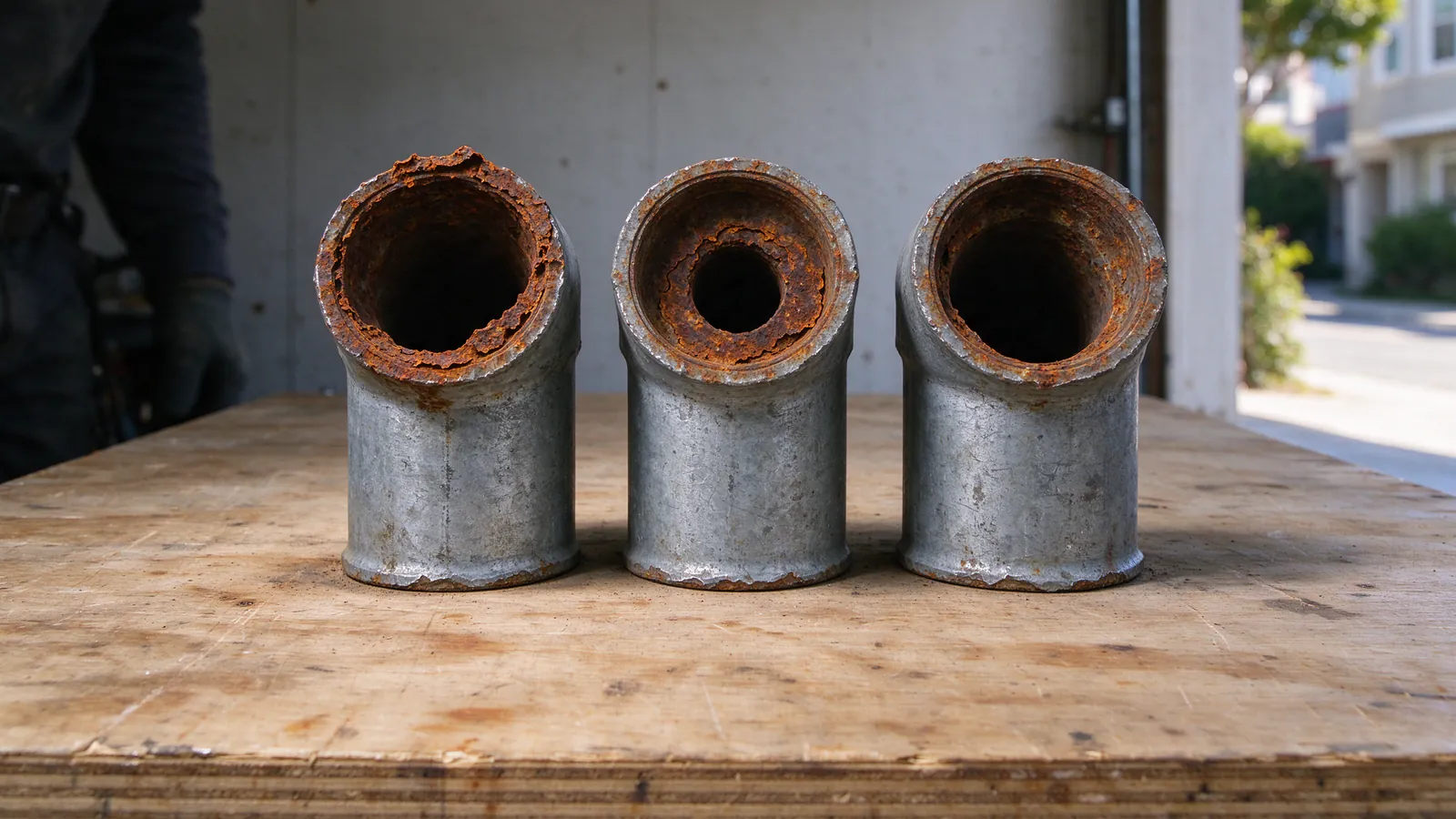
The San Francisco Public Utilities Commission publishes its water quality report every year, and the latest edition is out. For anyone living with older pipe, a handful of figures explain how that water treats galvanized steel and copper, and what the lead results do and don’t say about a particular building. Hilltop Repipe San Francisco offers and manages galvanized pipe replacement and repiping across San Francisco, Daly City and South San Francisco, carried out by licensed and insured contractors, so this reading focuses on the pipes.
What the report covers
The report describes the water SFPUC delivers inside San Francisco. Up to 85% of it comes from Hetch Hetchy Reservoir, which is exempt from filtration and is treated with ultraviolet light and chlorine, pH adjustment for corrosion control, fluoridation and chloramination. In the latest year, a small share of groundwater, about 0.42%, was blended in from deep wells in northern San Mateo County and western San Francisco. The report covers the water up to the meter. What happens between the meter and your faucet depends on the building.
Hardness: soft water
SFPUC reports hardness from 8.1 to 112 ppm as calcium carbonate, averaging 62, with alkalinity averaging 64 ppm and total dissolved solids averaging 95. That is soft water. It matters for old pipe because hard water leaves mineral scale inside pipes, and soft water mostly doesn’t. So when a galvanized line in San Francisco loses flow, the usual cause is the pipe’s own rust building on its inner wall, not scale. A repipe solves that; a water softener would not. The guide to San Francisco water and your pipes covers the chemistry in more depth.
pH and corrosion control
The report lists pH from 9 to 9.7, averaging 9.3. SFPUC raises the pH on purpose: water at that level is less aggressive toward metal, which slows corrosion and reduces how much metal leaches into the water. That treatment protects pipes going forward, but it cannot undo rust that has already narrowed a galvanized line over decades, or thin a copper wall back to new. The rusty water guide explains what brown water at the tap usually means.
Chloramine
San Francisco disinfects with chloramine rather than chlorine alone. The report gives a residual from below 0.1 to 3.6 ppm, with a highest running annual average of 2.6, under the maximum of 4.0. For a repipe, the practical point is compatibility: the manufacturer’s data for the pipe, fittings and seals should cover chloraminated drinking water. The California Plumbing Code also requires drinking-water pipe and fittings to comply with NSF/ANSI/CAN 61. The PEX vs copper guide compares the two.
The lead and copper results come from household plumbing
This is the section owners of old buildings should read twice. Under the federal Lead and Copper Rule, SFPUC samples taps inside customers’ homes every three years. In the latest round, at 50 sites, the 90th percentile for lead was 4.9 parts per billion, against an action level of 15, and for copper 72 ppb, against an action level of 1,300. The report lists the typical source of both as internal corrosion of household plumbing systems.
That wording matters. Lead at a San Francisco tap does not come from the city’s mains; it comes from inside buildings, from old solder, brass fittings and galvanized pipe. A good citywide number therefore says little about one building’s plumbing. Under the federal rule, the lead action level drops to 10 ppb starting November 1, 2027. The next round of sampling is scheduled for 2027. SFPUC tests an individual tap for $25, which gives an owner a fact about their own building before deciding anything. The guide to whether galvanized pipes are safe covers what to do with a result.
Want to know what your building's pipe is made of?
A walk-through traces it from the meter to every fixture and says what a repipe would involve.
The service line inventory
The report also updates SFPUC’s inventory of service lines, the buried pipes between the water main and each building. SFPUC removed all known lead service lines in the 1980s. Since then it has been replacing its own galvanized lines, some of which had short lead connectors, with copper; by the report’s count, 1,433 of 1,495 confirmed galvanized utility lines have been replaced, and lead connectors turned up in only 19% of those removed.
The owner’s side, from the meter box to the building, is a separate question. SFPUC estimates a 1% chance of lead in customer-owned lines, and its plumbers have never observed a customer-owned lead service line. It has identified 699 customer-owned galvanized lines it recommends replacing, because they may once have connected to lead components, and 109 of unknown material it is still confirming. Owners with those lines were notified by letter and can ask SFPUC for a free lead test and inspection. SFPUC is clear that the owner is responsible for replacing the customer-owned portion. Water service line replacement covers that work, and the guide to lead pipes in San Francisco separates fact from worry.
What the report can’t tell you
A citywide report describes the water, not the pipe in your walls. It can’t say whether your building has galvanized risers, a copper bathroom group with tired joints or a mix of both, and it can’t say whether a stain on a ceiling is a supply leak. Tracing the pipe from the meter is what answers that. The guide to identifying pipe material is a good place to start.
Outside San Francisco
Daly City and South San Francisco each publish their own report. Daly City blends Hetch Hetchy water, about 60% of demand, with about 40% groundwater from its own wells, and reports no known lead service lines. South San Francisco’s water comes from Cal Water, which blends SFPUC water with groundwater averaging 384 ppm of hardness, about six times San Francisco’s average; there, mineral scale is a real part of how pipes and water heaters age.