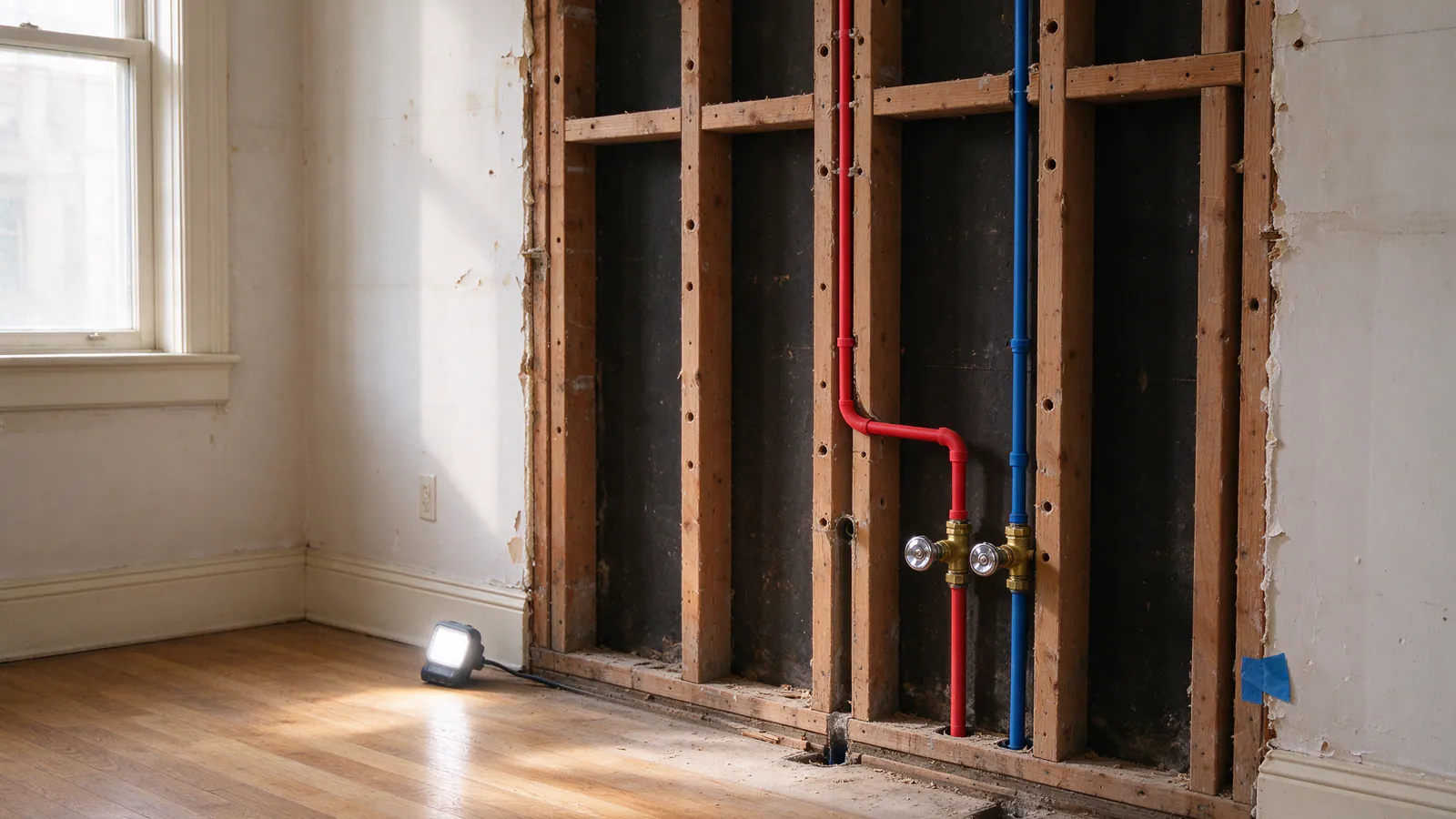
If the house or flat has old galvanized or tired copper supply pipe, the best time to replace at least the kitchen’s share of it is before the remodel closes the walls, and the time to decide is before demolition starts. Hilltop Repipe San Francisco offers and manages repiping during a renovation, from a partial repipe of the kitchen run to a whole-house repipe, across San Francisco, Daly City and South San Francisco, with the work carried out by licensed and insured contractors. This is the checklist for that window.
Why the timing matters
A kitchen remodel opens exactly the walls a repipe would otherwise have to open: behind the sink, at the dishwasher, at the refrigerator line, and often the floor or ceiling below. Running new supply lines while those walls are bare avoids most of the opening and patching the same work would need later, and it means the new cabinets, backsplash and tile never have to come off to reach a failing pipe. The reverse is the expensive case: a new kitchen fed by old pipe that starts leaking behind the finished wall.
There is also a quality reason. Galvanized pipe sheds rust, especially after the water has been shut off and turned back on, which a remodel does repeatedly. That rust ends up in new faucet cartridges, aerators and the dishwasher inlet. A kitchen fed by new pipe starts clean.
What the remodel already triggers
San Francisco’s plumbing amendments reach into a kitchen remodel whether or not the pipes are replaced. Under Section 606.3.1, any dwelling unit where a remodel is performed must meet Sections 606.2, 606.3 and 606.5: a fullway main valve where the supply enters, a valve on the water heater’s cold supply, a shutoff that lets the unit’s water be closed without affecting other units, and a control valve ahead of each fixture’s hot and cold supply. Sections 609.11.2 and 609.11.3 add air chambers on outlets serving quick-acting valves, which include single-handle faucets and the solenoid valves in appliances such as dishwashers.
In a flat that was piped long ago, meeting those rules can mean new valves at the building level as well as in the kitchen, and the pipe they attach to has to be sound enough to hold them. That is the point where the question of repiping comes up. The guide to how invasive repiping is shows what the added openings look like.
Permits travel together
DBI’s fee table puts a single kitchen or bath remodel in its single-unit plumbing category, and on PermitSF a kitchen remodel permit spawns separate plumbing and electrical permits. Adding a repipe changes the plumbing scope rather than adding a new process: a repipe of a house typically falls under DBI’s residential plumbing fee of $549, or $809 with underground work, with the category confirmed when the licensed contractor files. In a building of flats, DBI requires a separate permit for each existing apartment unit. Either way, the plumbing has to be inspected before the walls are covered, which fits a remodel schedule naturally. The San Francisco repiping permit guide has the details.
Kitchen only, or the whole house
A partial repipe can replace the lines from the main, or from a sound branch, to the kitchen. It costs less and touches fewer rooms, but it leaves the old pipe everywhere else, including the stretch that feeds the kitchen upstream, and every joint where new copper meets remaining galvanized needs a dielectric or insulating fitting. If the rest of the system is galvanized and already showing rusty water or falling pressure, the kitchen will keep receiving that water.
A whole-house repipe, done while the kitchen is open, uses the remodel’s openings for the hardest part of the route and leaves no old pipe upstream. For a house, the typical San Francisco-area range for a whole-house PEX repipe is about $8,500 to $16,000 with one bath, $12,000 to $22,000 with two and $14,500 to $28,000 with three, with copper usually higher and multi-story or hard-access homes running above the range. The repipe cost guide explains what moves the price, and the repipe vs repair guide covers when replacing the whole system is worth it.
Planning a kitchen remodel in an older house or flat?
A walk-through before demolition shows what feeds the kitchen and what a partial or whole-house repipe would add to the job.
Gas lines and the all-electric rule
A remodel is also when owners ask about the gas line to the range. Since July 1, 2026, San Francisco requires a Major Renovation to be all-electric, but only when both tests are met: the project is a significant alteration, and it replaces the space and water heating for the entire building, installs new systems serving 80% or more of the conditioned floor area, or adds systems for an addition. Reading those tests, a kitchen remodel on its own does not usually meet them, though DBI makes the call for each project. Where the range stays gas and the old gas pipe needs work, gas line repiping covers it as a separate permitted job.
Walls in older buildings
San Francisco presumes paint in buildings built before 1979 contains lead. In rented units and shared areas, Section 327 of the city’s Existing Building Code requires containment, a posted sign and three business days’ notice to occupants before painted surfaces are disturbed; interior work in an owner-occupied unit is exempt from the interior rules, though dust may not migrate into common areas. The Bay Area Air Quality Management District’s asbestos rule adds sampling before work in residential buildings of four or fewer units when textured or skim-coated wall surfaces will be disturbed. A kitchen remodel triggers both checks anyway, so a repipe in the same openings adds little to them.
A sequence that works
The order that avoids rework is simple. Have the pipe traced from the meter before demolition, so the remodel plan and the repipe scope are written together. Settle the route, the material and every opening. Let the remodel open the walls, run and pressure test the new supply lines, and pass the plumbing inspection before insulation, drywall or cabinets go in. The manifold vs trunk-and-branch guide covers one layout choice worth making at that stage.